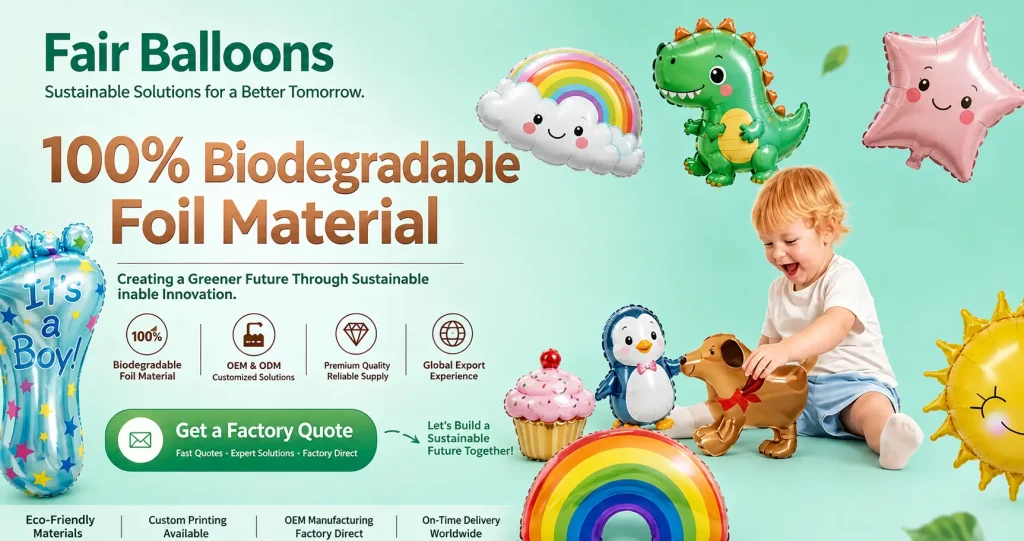

Helium Balloons Wholesale: Custom Foil Balloons for Retail, Events & Promotions
Looking for helium balloons for wholesale distribution, party supplies, event decoration, or branded promotions? The right product depends on balloon shape, size, material, print design, valve construction, packaging, and the conditions in which it will be used. This guide helps importers, distributors, and business buyers compare options and prepare a clearer request for quotation.
1. Choosing the Right Helium Balloons for Your Business
Helium balloons are used for birthdays, weddings, retail promotions, trade shows, store openings, seasonal displays, and branded events. For B2B buyers, the best choice is not simply the largest or least expensive balloon. It is the format that fits the application, presentation requirements, budget, and destination market.
Foil balloons, also commonly called Mylar balloons in the market, are popular for their reflective appearance, printed graphics, and availability in a wide range of shapes. Depending on the product design, foil balloons can be used as standalone decorations, coordinated party assortments, or part of a larger event display.
If you are sourcing helium balloons wholesale, start by identifying the intended use, target size, order quantity, artwork requirements, packaging format, and delivery destination. These details help a manufacturer assess the appropriate product construction and provide a more useful quotation.
Purchasing tip: Confirm whether the requested balloon is designed for helium inflation, air inflation, or both. Not every balloon shape or size is suitable for floating, and a product's suitability should be confirmed for the specific model.
2. Types of Helium Balloons: Match the Format to the Application
Different helium balloon formats serve different commercial purposes. Shape, inflated volume, visual weight, and the position of the valve all affect the finished display. The following categories are useful starting points when planning a wholesale order.
| Balloon Type | Common Applications | What Buyers Should Confirm |
|---|---|---|
| Round or star foil balloons | Birthday assortments, celebrations, retail party supplies, and event decoration. | Finished size, artwork, color, valve compatibility, and intended inflation method. |
| Number and letter balloons | Milestone birthdays, anniversaries, graduations, and personalized displays. | Character height, style consistency, valve position, and whether the design is intended to float. |
| Shaped foil balloons | Seasonal promotions, themed parties, retail displays, and licensed or original character concepts. | Shape proportions, artwork ownership, construction, and helium suitability of the finished design. |
| Custom printed balloons | Brand campaigns, product launches, corporate events, and promotional giveaways. | Print coverage, color references, logo placement, artwork approval, and packaging. |
| Coordinated balloon assortments | Party kits, seasonal collections, retail programs, and event supply packages. | SKU mix, quantities per design, barcode and label requirements, and carton packing. |
For distinctive silhouettes, review our guide to custom shaped foil balloon customization. If your project requires a product designed around a brand, campaign, or original artwork, our shaped foil balloon OEM service is another useful starting point.
3. Foil Balloon Materials: Appearance, Construction, and Performance
Material selection affects the balloon's appearance, flexibility, weldability, and gas-retention behavior. The construction used for one model should not automatically be assumed to apply to every product in a supplier's catalogue.
Metallized film and composite structures
Many foil balloons use polymer films with a thin metallized layer that creates the familiar reflective finish. Depending on the product, the construction may use polyester-based film or a composite structure incorporating other polymer layers. The exact material and layer arrangement should be confirmed for the model being quoted.
Why the finished construction matters
- Appearance: Metallic, glossy, matte, holographic, and other finishes create different visual effects.
- Formability: Material flexibility and the shape design affect how the balloon forms during inflation.
- Sealing: The selected film must be compatible with the product's heat-sealing and valve construction.
- Gas retention: Film structure, seam quality, valve performance, inflation level, and use conditions all contribute to how long a helium-filled balloon remains buoyant.
For a closer look at production stages, see the foil and Mylar balloon manufacturing process. If your programme includes printed artwork, the foil balloon printing methods guide can help you prepare design and finish requirements before requesting a quotation.
Important: A material description alone does not establish a guaranteed float time or compliance status. Request the applicable product specification and any test documentation relevant to your intended use and destination market.
4. How Long Do Helium Balloons Float?
There is no single float-time figure that applies to every helium balloon. Actual buoyancy duration depends on the balloon's size and shape, the materials used, the quality of its seams and valve, the inflation level, and the surrounding temperature and handling conditions.
A balloon may also appear smaller in a cooler environment because the gas contracts. This visual change does not necessarily mean that helium has escaped. When the balloon returns to a warmer environment, it may expand again if the gas remains inside. If it stays visibly deflated after returning to a normal temperature, gas loss or another issue may be involved.
| Factor | Why It Matters | Buyer Action |
|---|---|---|
| Balloon size and shape | Different shapes have different volumes, surface areas, and lift requirements. | Provide the intended size and exact shape or reference artwork. |
| Film structure | Gas transmission varies with material composition and construction. | Ask for the relevant product specification rather than relying on a generic material claim. |
| Valve and seams | Leakage can occur at the valve, the valve attachment, or the sealed edges. | Ask how the product is inspected and how sample performance can be evaluated. |
| Temperature | Gas volume changes with temperature, affecting the balloon's visible size and internal pressure. | Consider the expected conditions during storage, shipping, and use. |
| Inflation and handling | Overinflation, damage, and improper handling may affect performance. | Confirm inflation instructions and handling guidance for the specific product. |
For a meaningful comparison, ask the supplier to state the test conditions behind any quoted float-time figure, including the product model, inflation method, temperature, observation period, and evaluation criteria. A test result for one model should not be treated as a guarantee for every size or shape.
5. Self-Sealing Valves and Heat-Sealed Edges
Many foil balloons use a self-sealing valve that allows inflation gas to enter and then closes when the nozzle is removed. The valve is a small component, but its design and integration can influence the finished product's performance.
Potential problems include a valve that does not close properly, damage during nozzle insertion, a weak valve-to-body attachment, or an imperfect seam. These issues may not be obvious from a product photograph, which is why sample evaluation and agreed inspection requirements are important for wholesale orders.
Questions to ask before approving a sample
- Is the balloon designed for helium inflation, air inflation, or both?
- Is the valve compatible with the intended inflation nozzle?
- What inspection procedure is used for the valve and sealed edges?
- Can the supplier provide a sample for an agreed inflation and retention evaluation?
- What handling or inflation instructions should accompany the product?
Read our detailed guide to the foil balloon self-sealing valve to understand how the valve works and what to check when evaluating samples.
6. Custom Helium Balloons: Printing, Shapes, and OEM Requirements
For brands, wholesalers, retailers, and event companies, custom helium balloons can help turn a standard decoration into a product that matches a campaign or visual identity. Depending on the design and production requirements, customization may include printed logos, colors, artwork, shaped outlines, assortment combinations, and retail packaging.
Artwork and print preparation
Provide vector artwork where available, together with the required dimensions, color references, print positions, and any areas that must remain clear for seams or valves. Before mass production, review the sample or artwork proof to confirm that the key visual elements remain legible on the intended balloon shape.
For technical guidance on print options and design considerations, visit our foil balloon printing methods page.
Custom shapes and promotional projects
Custom shapes may require additional review because the outline, internal volume, balance, and valve position can affect both the appearance and intended use of the finished balloon. If the project is for a brand activation or corporate campaign, see our custom advertising balloons OEM page.
Artwork rights and licensed characters
For branded artwork, mascots, or recognizable characters, buyers should provide the necessary rights or authorization for commercial production. A supplier should not assume that an image found online is cleared for manufacturing, export, or resale.
Sample approval: Confirm the actual shape, print appearance, inflation method, packaging, and any product-specific requirements before authorizing bulk production. Changes to artwork or dimensions after approval may affect the final result.
7. Quality Control: What Wholesale Buyers Should Check
Quality requirements should be agreed according to the product, order, and intended market. A useful quality plan distinguishes visible appearance checks from checks that require inflation or other functional evaluation.
| Inspection Area | What to Review | How to Define Acceptance |
|---|---|---|
| Appearance and print | Color consistency, artwork placement, surface finish, and visible marks. | Approve a reference sample and identify unacceptable defects. |
| Shape and dimensions | Outline, inflated appearance, and dimensions relevant to the product specification. | Specify whether measurements refer to the flat or inflated product. |
| Seams and valve | Visible sealing defects, valve alignment, and damage around the inflation opening. | Agree on inspection methods and any functional tests required. |
| Inflation performance | Behavior during inflation and the agreed observation period. | Define the sample size, test conditions, observation period, and acceptance criteria. |
| Packaging and labels | Quantity per pack, product identification, barcodes, warnings, and carton markings. | Approve packaging artwork and the final packing specification. |
Before placing a large order, buyers should ask which checks are performed on the relevant product, whether inspection is based on sampling or full inspection, and what records can be supplied. Inspection methods and acceptance criteria should be confirmed in writing rather than assumed to be identical across all product lines.
For more detail, see our foil balloon quality control guide and review the applicable reports or product documents for the exact SKU being purchased. The existence of a test report does not automatically mean every product or material in a catalogue has been tested to the same standard.
8. Wholesale Helium Balloons: What to Include in an RFQ
A clear request for quotation helps the supplier assess the product and reduces avoidable back-and-forth. Before contacting a helium balloon manufacturer, prepare as much of the following information as possible.
- Product type: Round, star, number, letter, shaped, custom printed, or a coordinated assortment.
- Size: Specify the required dimensions and whether they refer to the flat or inflated balloon.
- Inflation method: State whether the product must be suitable for helium, air, or both, and request confirmation for the specific design.
- Quantity: Provide the estimated order quantity by model, design, and size.
- Artwork: Attach the logo or design file, color references, print positions, and any relevant usage authorization.
- Packaging: Specify individual bags, retail packs, assortments, barcode labels, instruction inserts, and carton requirements.
- Destination market: State the country or region where the product will be sold or used, so relevant documentation requirements can be reviewed.
- Quality requirements: Identify the sample approval process, functional checks, inspection method, and any agreed acceptance criteria.
- Schedule: Share the target sample approval date and required shipment window so feasibility can be assessed.
For supplier background and production information, visit the foil balloon manufacturer page. To discuss your specific project, contact our team through the contact page.
Quotation reminder: Minimum order quantities, tooling requirements, sample charges, production schedules, and shipping arrangements can vary by design and order. Confirm the applicable terms in the quotation instead of relying on a general figure from another product.
9. Frequently Asked Questions About Helium Balloons
Helium balloons are filled with helium gas, which can provide lift when the balloon's overall weight and volume allow it to float. Air-filled balloons are commonly used for arches, garlands, and mounted displays. Whether a particular foil balloon can float depends on its design, size, materials, and accessories, so confirm the intended inflation method for the exact model.
Float duration varies with the balloon's size, shape, film structure, seams, valve, inflation level, and environment. Ask the supplier for a product-specific estimate and the conditions under which it was evaluated. A general estimate should not be treated as a guarantee for every model or use environment.
Custom printing may be available depending on the product format and artwork requirements. Prepare the logo or design file, dimensions, color references, quantity, and packaging requirements. Confirm artwork approval, sample availability, and any applicable setup or tooling costs before placing the order.
No. Some products are intended primarily for air inflation, while others may be designed for helium. The finished shape, volume, weight, and construction affect whether a balloon can float. Confirm suitability for the specific SKU before purchase and do not assume that every shape or size in a catalogue has the same performance.
Confirm the product type, dimensions, inflation method, artwork, packaging, quantity, destination market, and inspection requirements. Review a representative sample where appropriate, and ensure that the final specification and quotation agree on the product and acceptance criteria.
Document availability depends on the product, material, test scope, and destination market. Tell the supplier which standards or documents your programme requires, and ask for the applicable reports for the specific product. A report for one sample or material should not be assumed to cover every product in a catalogue.
Provide a product reference or design file, required dimensions, order quantity, inflation method, print details, packaging specification, destination market, and target schedule. If you need a new shape, mention whether you have a finished dieline or need the design feasibility reviewed.
Helium is non-flammable, while hydrogen is highly flammable and can form explosive mixtures with air. Use helium or another filling method specifically permitted for the product and application, and follow local safety requirements and the relevant inflation instructions. Never substitute hydrogen for helium in a balloon intended for helium use.
Looking for a Helium Balloon Wholesale Supplier?
Share your product references, target sizes, quantities, artwork, packaging requirements, and destination market. Our team can review your enquiry and advise on the product options, customization requirements, and documentation that may be applicable to your project.
Explore our foil balloon manufacturing information, manufacturing process, printing methods, self-sealing valve guide, and quality control guide.
Request a Quotation → Email: xia@foilballoon.cnPlease include your target quantity, required specifications, packaging details, and destination market for a more accurate quotation.