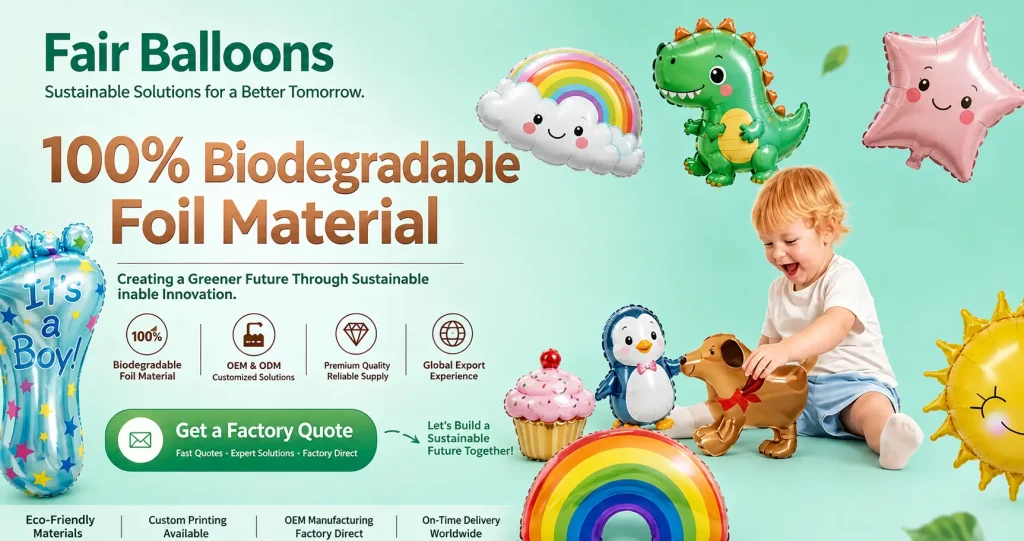

Biodegradable Mylar Balloons Wholesale: Custom Eco-Friendly Balloons
"Biodegradable" is the most abused word in the balloon industry. Half the suppliers using it are selling a conventional BOPET balloon with a green logo on the header card. The other half are selling a PLA blend that is technically compostable in a laboratory but will never break down in a home trash can or a landfill. Before you sign a biodegradable balloon contract, you need to read the actual test report — not the certificate, not the marketing claim, the actual PDF from an accredited lab.
I. Six Verification Gates Before You Sign the Contract.
Demand for biodegradable balloons is being driven by three real pressures: corporate ESG commitments that require demonstrable environmental action, retailer vendor requirements for sustainable products, and regulatory pressure on single-use plastics in the EU and US markets. Those pressures are legitimate. The problem is that the supply chain has responded to them with claims that range from accurate to outright fabricated, and the buyer has no way to tell the difference without reading the paperwork.
These six questions separate a genuine biodegradable balloon program from a greenwashed one. If a supplier cannot answer all six with documentation, the "biodegradable" label on their product is a legal exposure for you, not a sustainability credential.
II. Greenwashing Claims That Should End the Conversation.
Greenwashing in the balloon category follows predictable patterns. Suppliers who cannot produce a real test report often try to substitute a different kind of claim that sounds equivalent. Below are the four phrases that should end the conversation immediately if a supplier uses them.
III. What Our Biodegradable Balloon Program Ships With.
Our biodegradable balloons are built on a PLA+PBAT bio-polymer film construction. The composite combines Polylactic Acid derived from renewable plant feedstock with Polybutylene Adipate-co-Terephthalate, a compostable polymer that provides the flexibility and film strength the PLA alone cannot deliver. The finished balloon carries the same metallization and print quality as our standard line, so the sustainability claim does not come at the cost of shelf appearance.
Third-party biodegradation test data is available on request, with the finished product tested — not just the raw polymer pellets. The test reports name the laboratory, list the accreditation number, and state the standard the material was tested against. We supply the full report as a PDF, not a marketing certificate. If the report is more than three years old, we confirm whether the formulation has changed since the test was run, and re-test if it has.
Full-color custom printing with your brand logo is available on the biodegradable line. Standard shapes include round, heart, star, letter, and number; custom shapes are available at higher MOQ with new CNC tooling and 3D stress modeling. EN71, CE, and RoHS compliance documentation ships with the container — the same physical documentation protocol we run on the standard line, not a separate compliance process.
IV. MOQ, Lead Time & the Production Reality
MOQ reality: True custom biodegradable balloon orders require 2,000 pieces minimum. The biodegradable material is produced to order, not stocked, and the tooling and print setup costs cannot be amortized across a smaller run without compromising quality or material authenticity. If a supplier offers 100 pieces custom printed at a very low price, question the product quality and the material authenticity — one of those two is not what they say it is.
Stock policy: Biodegradable materials are produced to order. We do not carry finished goods inventory of biodegradable balloons. This is a real constraint on lead time, and it is also the reason the material can be verified batch by batch. If you need biodegradable balloons for a specific retail window or seasonal program, the booking window has to account for the material production lead time on top of the standard production and shipping schedule.
Lead time: varies by quantity and design complexity. Send the artwork, the target quantity, the standards your compliance department requires, and the destination port with your inquiry. We respond with a specific production calendar and an in-DC date, not a vague estimate.
Every order ships flat-packed in heavy-gauge anti-static polybags with silica gel desiccant, then nested inside five-layer double-corrugated export cartons rated to ECT-44 for crush resistance in deep-sea freight. The biodegradable line runs on the same packout spec as the standard line — the environmental claim does not come at the cost of physical protection in transit. Contact the sourcing team at xia@foilballoon.cn with your compliance requirements, target quantity, artwork, and destination port.
V. Buyer FAQ: Biodegradable Mylar Balloons
EN 13432 and ASTM D6400 are industrial composting standards. They define degradation in a controlled facility at sustained high temperatures and controlled humidity — conditions that exist in commercial composting operations but not in a home compost bin or a landfill. OK Compost HOME is a stricter standard that certifies degradation at ambient temperatures, which is what a home compost system actually sees. When a supplier claims "compostable," ask which standard the test report cites. A balloon certified to an industrial standard but sold into a market without industrial composting infrastructure does not deliver the environmental benefit the buyer is paying for.
Material-level testing does not guarantee that the finished product biodegrades. The metallization layer, the print inks, the valve components, and the heat-seal adhesives can all change the degradation profile of the finished balloon. A pellet test certifies that the polymer is compostable; it does not certify that the assembled balloon is. Finished product testing is the only version that maps to what the customer actually receives. If the test report says "resin" or "pellet" and not "balloon," the claim is incomplete.
Three to four years is the practical limit. Polymer formulations evolve — stabilizers, plasticizers, and processing aids get swapped out during production optimization — and a test on an old formulation does not certify the current production. If the report is older than three years, ask whether the material formulation has changed since the test was run. If it has, the certification needs to be re-issued against the current formulation. A supplier who can only produce a four-year-old report is asking you to trust that nothing has changed, which is not how compliance works.
Oxo-degradable plastics fragment into microplastics. They do not biodegrade in any environment. Several jurisdictions, including the EU, have banned oxo-degradable claims in consumer products because the fragmented residue is environmentally worse than the intact polymer. A supplier offering oxo-degradable balloons is offering a product that will fail any serious environmental audit — and the buyer who accepts the claim inherits the compliance exposure. If a supplier uses the term "oxo-degradable," end the conversation and source elsewhere.
Two reasons. The biodegradable material is produced to order, not stocked — this is not a factory policy, it is a material reality. The bio-polymer film has a limited shelf life once produced, so carrying finished goods inventory of biodegradable balloons is not practical. The tooling and print setup costs also cannot be amortized across a smaller run without compromising quality or material authenticity. If a supplier offers 100-piece custom printed biodegradable balloons at a low price, one of the following is true: they are using a conventional BOPET balloon and calling it biodegradable, or they are sourcing a cheap PLA blend with no verified certification.
The finished-product biodegradation test report as a PDF, naming the laboratory, the accreditation number, and the test standard. EN71, CE, and RoHS compliance documentation. The product specification sheet confirming the PLA+PBAT composite construction. All documentation ships with the container, not by separate email. If the test report is more than three years old, we confirm whether the formulation has changed since the test was run, and re-test if it has. Contact the sourcing team with the specific standards your compliance department requires before we quote.
Talk to the Line, Not a Trading Desk
For biodegradable mylar balloon wholesale pricing and test documentation, contact us at xia@foilballoon.cn. Response within 12 hours. We answer with documents, not brochures.
Kunshan Fair Craft Products Co., Ltd. · Foil Balloon Manufacturer · www.foilballoon.cn/en/home/