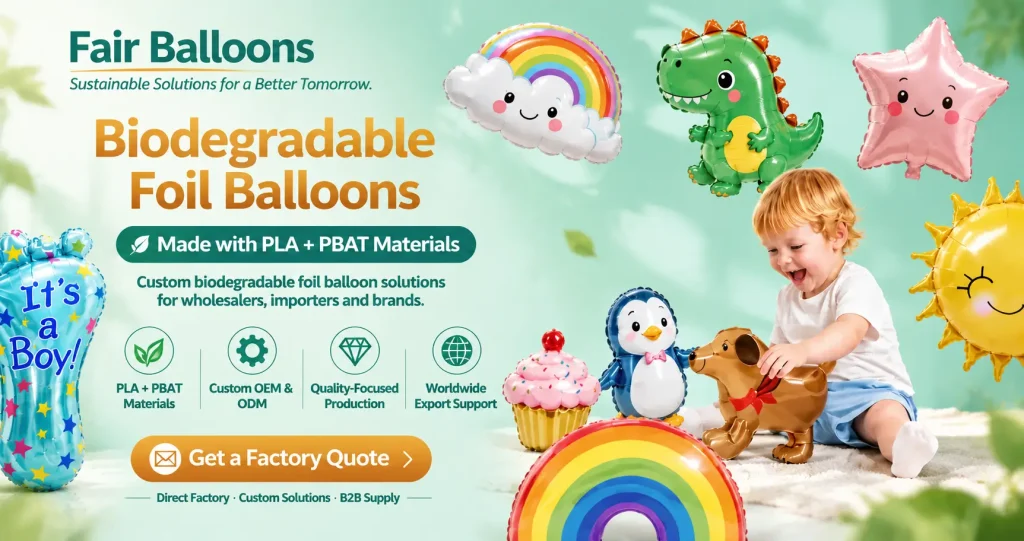

Foil Balloon Manufacturer in China for Custom OEM Production
A practical sourcing guide for importers, distributors, retailers and brand owners evaluating a foil balloon manufacturer in China. Learn how to assess factory capabilities, compare custom production options, review test documentation and prepare a clear OEM or ODM inquiry.
Executive Summary
FAIR (Kunshan Fair Craft Products Co., Ltd.) is a China-based foil balloon manufacturing business established in 2007. We work with B2B buyers on standard and custom foil balloon projects, including printed designs, shaped balloons, letters and numbers, and project-specific OEM/ODM requirements.
This guide explains what buyers should check when selecting a foil balloon factory: product specifications, material options, artwork, tooling, samples, quality requirements, documentation and order terms. Each project's MOQ, production schedule and technical scope should be confirmed against its actual requirements.
Start with our foil balloon product catalog, learn about letter foil balloons and number foil balloons, or contact our team about a custom project.
1. Why Source from a China Foil Balloon Factory?
China is an established sourcing base for foil balloons. Buyers can evaluate manufacturers offering different combinations of product development, printing, shaping, tooling coordination and export support. The right partner depends on the required product, order volume, quality expectations, destination market and communication process.
Direct Technical Communication
Working directly with a manufacturer can make it easier to discuss artwork, dimensions, material structure, sample revisions and production requirements with the team responsible for the project.
Custom Product Development
Custom foil balloon programs may involve shape assessment, artwork preparation, tooling coordination, printing requirements and sample approval. Confirm the scope and responsibilities before production.
Product Range
Buyers can source standard shapes, printed designs, letters, numbers and project-specific shapes. Explore the FAIR foil balloon range.
Project-Based Sourcing
Specifications, MOQ, packaging, inspection and delivery arrangements can be reviewed together instead of evaluating a quotation by unit price alone.
Buyer reminder: Compare quotations using the same product specification, material, size, printing coverage, packaging and inspection requirements. A lower unit price is not necessarily a like-for-like offer.
2. How to Evaluate a Foil Balloon Manufacturer
A supplier's website or product catalog is only the starting point. Before placing a substantial order, buyers should establish who is responsible for manufacturing, which production steps are performed in-house or externally, and how the supplier will document the agreed specifications.
Check the Company and Manufacturing Scope
Review the company's registered business information and confirm that its actual business activities are consistent with the manufacturing services being offered. Ask for a clear explanation of the production steps, facility arrangements and any subcontracted processes relevant to your order.
Review Samples and Specifications
Request a sample or approved reference for the intended design. Confirm the inflated appearance, dimensions, print layout, valve position, material description and packaging requirements. Keep the approved sample and specification as the reference for the purchase order.
Ask How Quality Requirements Are Recorded
Discuss the inspection points, acceptable defect criteria, sample size, inspection timing and corrective-action process. Put the agreed requirements in writing rather than relying on general statements such as “high quality” or “strict quality control.”
Useful audit questions: Which steps are performed at the factory? Which steps are subcontracted? Can the supplier show relevant samples? How are artwork changes approved? Which documents apply to the exact product being quoted?
3. Custom Foil Balloon Production: What Buyers Should Prepare
Custom foil balloon manufacturing starts with a clear product brief. The more complete the information, the easier it is to assess design feasibility, tooling requirements, sampling, MOQ and quotation details.
Custom Printed Balloons
Provide artwork, logo files, print colors, print coverage, intended use and any brand guidelines. See our foil balloon product range for product context.
Custom Shapes
Provide a reference image, drawing, target dimensions and the desired inflated appearance. The factory can review whether additional tooling or design adjustment is required.
Letter Balloons
Specify the alphabet, size, color, finish and quantity by character. Browse the letter foil balloon range.
Number Balloons
Specify the numbers, dimensions, colors and quantity mix. Browse the number foil balloon range.
Artwork, Tooling and Sample Approval
Before production, agree on the artwork version, dimensions, material, print requirements, valve position, packaging and sample approval procedure. If a custom shape requires tooling, confirm the tooling scope, cost, ownership arrangements and expected development steps in the quotation.
OEM and ODM Project Coordination
OEM projects generally begin with the buyer's design or specification. ODM projects may involve more product-development discussion. In either case, the final scope should identify the approved design, product specifications, packaging, quantity and documentation requirements.
Tooling resources: FAIR has access to a resource library of more than 1,500 molds, combining in-house molds with molds available through manufacturing partners. Mold suitability and availability should be checked against the requested design, dimensions and production requirements. If new tooling is needed, confirm the tooling scope, cost and ownership arrangements in the quotation.
4. Foil Balloon Materials and Product Options
Foil balloons are made using flexible film structures with a metallized appearance. The exact construction can vary by product and supplier. Buyers should request the material specification for the particular SKU instead of assuming that all foil balloons use the same film combination.
Conventional Foil Balloon Materials
Different film structures can offer different balances of mechanical properties, barrier performance, appearance, sealing characteristics and cost. Material selection should be evaluated against the balloon's size, shape, intended inflation method, performance expectations and target price.
Custom Shape and Printed Options
Shape, size, print coverage, color and finish all affect the final product specification. Buyers should review the physical sample and the written specification together before approving mass production.
Separate Biodegradable-Oriented Product Line
FAIR also discusses PLA/PBAT-based biodegradable-oriented foil balloon products as a separate material option. These products should not be confused with conventional foil balloon constructions. Any environmental statement must be limited to the specific material, sample and test evidence available.
Important: Do not assume that a material description alone proves compostability or biodegradation in every environment. Buyers should review the complete test method, conditions, sample identity and result before making an environmental claim.
5. Test Reports and Product Documentation
Test reports are evidence for the sample and test scope stated in each document. They should not be presented as blanket certifications for every product, material, color or SKU. Before relying on a report, check the report number, sample description, test method, date, results and applicability to the product being purchased.
| Document | Available Reference | Important Scope Note |
|---|---|---|
| SGS RoHS test report | SHAHG2207652301 | Report for the tested “DEGRADING BALLOON” sample under the stated RoHS test scope. Do not assume it covers every conventional foil balloon SKU. |
| SGS EN 71 test report | SHTY130500007975-01 | Historical report dated 2013. Review the original report for sample identity, standard editions, clauses and results. Confirm whether it is suitable for the intended current product and market. |
| SGS ISO 14855-1:2012 biodegradation test report | SHMR220700361301 | Tested PLA degrading balloon sample. The report records 77.8% average biodegradation over 45 days at 58±2°C. This is test evidence, not a certification scheme. |
| PEBA membership | Membership documentation | Industry membership is not a product certification or a substitute for product-specific testing. |
How Buyers Should Request Documentation
Tell the factory the destination market, product type, material construction and SKU. Specify which tests or regulatory documents your customer or local adviser requires. The factory can then review which available documents are relevant and whether additional testing needs to be arranged.
Compliance boundary: ISO 14855-1:2012 is a biodegradation test method. The available SGS report does not establish that all FAIR products are certified industrially compostable. Report applicability must be checked against the exact product and claim.
6. Quality and Inspection Planning
A clear quality plan helps both buyer and manufacturer understand what will be checked and how acceptance will be determined. The inspection plan should be agreed before production, particularly for custom artwork, special shapes and retail packaging.
FAIR's Batch Sampling and Inspection Approach
FAIR conducts batch-based sampling inspections for finished foil balloons. AQL 2.5 is applied to finished-product appearance and leak inspection. For leak checks, sampled balloons are manually inflated and observed during a holding check. This is a manual inspection method, not an automated leak-detection station.
The inspection scope and acceptance requirements should be agreed for the specific order, including the product specification, sampling arrangement and defect criteria. The holding-check duration is not presented as one fixed period for every product or order. Helium retention should not be treated as a guaranteed number of days unless a product-specific result has been established and agreed.
Typical Points to Define
- Product dimensions and approved inflated appearance.
- Material description and agreed construction.
- Artwork version, print position, colors and acceptable print variation.
- Sealing, valve and visual appearance requirements relevant to the product.
- Packaging, labeling, carton marks and quantity per pack.
- Inspection timing, batch sampling arrangement and defect acceptance criteria.
Understanding AQL 2.5: AQL 2.5 is an inspection acceptance level. It does not mean that 2.5% of the products are sampled or that a 2.5% defect rate is automatically acceptable. The applicable sample quantity and acceptance criteria depend on the agreed inspection plan and order details.
Pre-Shipment Inspection
Buyers may discuss a pre-shipment inspection with the factory or arrange an independent inspection provider. Confirm the inspection scope, date, sampling plan, acceptance criteria, access arrangements and costs in advance. A third-party inspection report is useful only when it is tied to clearly agreed criteria.
Practical recommendation: Keep the approved sample, artwork proof, specification sheet and inspection criteria together as the reference set for the order.
7. MOQ, Samples and Production Lead Time
Minimum order quantity and production timing depend on the product type, design, material, printing, tooling, packaging and order volume. They should be confirmed in the quotation rather than assumed to be identical across all products.
Custom MOQ
Custom projects commonly start from around 10,000 units. The final MOQ depends on the design, material, printing, tooling and order configuration.
Samples
Sample requirements and development arrangements depend on whether the project uses an existing design or requires new artwork, tooling or other development work.
Production Schedule
Production timing is confirmed after the product specification, order quantity, sample approval and current production schedule have been reviewed.
Quotation Details
Ask for the quotation to identify product price, tooling or sample charges, packaging, inspection arrangements and agreed delivery terms.
Information to Include in an RFQ
- Product type, shape and target dimensions.
- Artwork, logo or reference images.
- Material preference, if already specified.
- Printing, color and finish requirements.
- Estimated quantity and quantity by design.
- Packaging and labeling requirements.
- Destination country and required documentation.
- Target order timing and any inspection requirements.
8. FAQ for B2B Foil Balloon Buyers
How do I verify a foil balloon manufacturer in China?
Review the company's registered business information, clarify which production steps it performs, request relevant product samples and specifications, and discuss how quality requirements and documentation are handled. A factory visit or independent audit may provide additional verification.
What is the MOQ for custom foil balloons?
Custom projects commonly start from around 10,000 units. The actual MOQ depends on the design, material, printing, tooling and order configuration. Confirm the final quantity with the factory for each project.
Can FAIR manufacture custom printed foil balloons?
FAIR works with B2B buyers on custom foil balloon projects. Share your artwork, product dimensions, printing requirements, estimated quantity and packaging needs so the project can be reviewed.
Can FAIR produce custom-shaped foil balloons?
Custom shape feasibility depends on the design, dimensions, construction and tooling requirements. FAIR has access to more than 1,500 molds through a combination of in-house and partner resources. Provide a drawing or reference image so mold suitability and any additional tooling needs can be assessed before confirming the quotation and sample plan.
How does FAIR inspect foil balloon quality?
FAIR uses batch-based sampling inspections. AQL 2.5 is applied to finished-product appearance and leak inspection. Leak checks involve manual inflation and holding observation. The inspection details and acceptance requirements should be confirmed for the specific order.
Does FAIR use automated leak-detection equipment?
Leak inspection described on this page is based on manual inflation and holding observation of sampled balloons. It should not be interpreted as an automated leak-detection process or as a claim of 100% inspection.
Does FAIR have SGS test reports?
There are available SGS test reports for specified samples, including RoHS, EN 71 and ISO 14855-1:2012 biodegradation testing. Each report has its own sample and test scope. Ask the team to confirm whether a particular report applies to your intended SKU.
Does the ISO 14855-1 report mean every foil balloon is biodegradable?
No. The report relates to the tested PLA degrading balloon sample under the stated laboratory conditions. It does not establish biodegradation performance for every material, product or environmental condition.
How long does custom production take?
Lead time depends on design approval, sample and tooling requirements, order quantity, packaging and the production schedule. The factory confirms the applicable schedule during quotation and order confirmation.
What should I send to request a quotation?
Send the product type, reference image or artwork, target size, material preference, quantity, packaging requirements and destination market. These details help the team assess the project and prepare a more relevant quotation.
9. Work with FAIR on Your Custom Foil Balloon Project
FAIR (Kunshan Fair Craft Products Co., Ltd.) works with B2B buyers on foil balloon manufacturing and custom OEM/ODM projects. If you are developing a new product, expanding an existing range or reviewing a manufacturing partner, share your requirements so the project can be assessed against its actual specifications.
You can first browse the foil balloon catalog, review letter balloons and number balloons, or learn more about the company through the FAIR website homepage.
Prepare Your Factory Inquiry
Include your product type, artwork or reference image, target dimensions, estimated quantity, packaging requirements and destination market. Our team can review the project requirements and confirm the applicable MOQ, sample arrangements, documentation and production schedule.
Contact: xia@foilballoon.cn
Discuss Your Foil Balloon OEM Project
Send your product brief to FAIR and discuss custom foil balloon manufacturing requirements directly with our team.
Contact FAIRRelated Product Pages
The information on this page is general B2B sourcing guidance. Product specifications, MOQ, sample arrangements, production schedules, inspection criteria and documentation applicability must be confirmed for each order. Test reports apply only to their stated samples and scopes.