Biodegradable Mylar Balloon Technology: PLA-PBAT Materials and Performance
Are Mylar balloons biodegradable? The answer depends on the material used to make the balloon,
not simply on whether it looks like a conventional foil balloon. This guide explains the
differences between conventional foil films and PLA-PBAT biodegradable balloon materials,
how film engineering affects finished-product performance, and how to interpret biodegradation
test evidence.
FAIR's biodegradable Mylar balloon technology focuses on PLA-based material systems and the
practical requirements of converting film into finished balloons, including printing,
heat sealing, valve integration and product validation for wholesale and OEM projects.
Technical information is provided for material evaluation. Actual specifications and test
documentation must be checked against the relevant product SKU.
The term "biodegradable Mylar balloon" is commonly used by buyers searching for a
foil-style balloon made with an alternative material. However, conventional Mylar balloons
and biodegradable foil-style balloons are not necessarily made from the same polymer system.
Conventional foil balloons commonly use plastic film structures such as polyester-based
film combined with a sealing layer. Biodegradable foil-style balloons require a different
material approach. PLA (polylactic acid) and PBAT
(poly(butylene adipate-co-terephthalate)) are two polymers used in biodegradable material
development. Their formulation and processing need to be adapted to the requirements of
balloon film.
A finished balloon is more than a sheet of film. Its usability depends on the combined
performance of the material, printed surface, sealed edges, valve area and finished-product
design. Evaluating biodegradable balloon technology therefore requires both material
information and product-level validation.
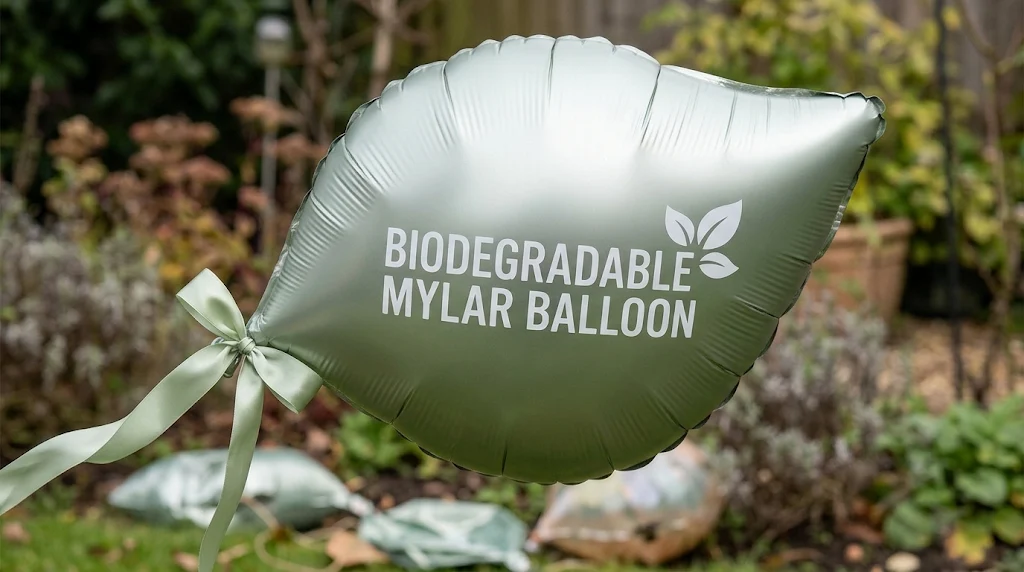
Biodegradable foil-style balloon development requires material selection and finished-product evaluation.
1. Are Mylar Balloons Biodegradable?
Not all Mylar balloons are biodegradable. The word "Mylar" is often used in the balloon
industry as a familiar term for foil-style balloons, but it does not identify one universal
biodegradable material.
Many conventional foil balloons use polyester-based film, often combined with a polymer
sealing layer. These conventional structures should not be assumed to biodegrade simply
because the finished balloon has a metallic appearance or is marketed as a foil balloon.
A biodegradable foil-style balloon must use a material system designed and tested for
biodegradation under specified conditions. PLA-based formulations, including PLA-PBAT
material systems, are used in the development of such products. Actual biodegradation
performance depends on the formulation, finished product and test method.
Important distinction: "Mylar" is commonly used as a product-category
reference in balloon searches. It is not proof that a balloon is biodegradable. Buyers
should request the actual material description and relevant test evidence for the product
they intend to purchase.
Are Mylar and foil balloons the same?
In everyday balloon purchasing, "Mylar balloon" and "foil balloon" are often used to refer
to the same general product category: lightweight, heat-sealed decorative balloons made
from film. Technically, however, "foil" can describe the product's appearance or category
rather than a precise polymer composition.
For material sourcing, buyers should look beyond the product name. Ask whether the balloon
uses conventional polyester-based film, a PLA-based biodegradable film system, or another
specified material structure.
2. What Are Biodegradable Balloons Made Of?
PLA and PBAT are two polymers used in biodegradable material development. They have
different characteristics, which is why they may be combined in a formulation intended
for flexible film applications.
PLA: Polylactic Acid
PLA is a polymer commonly produced from fermented plant-derived sugars or starch sources.
It is used in a range of bio-based and biodegradable material applications, depending
on the formulation and the conditions under which it is tested.
For balloon film, PLA is part of a material system that must be engineered for converting
and finished-product requirements. The presence of PLA alone does not establish the
performance of a complete balloon.
PBAT: Poly(butylene adipate-co-terephthalate)
PBAT is a biodegradable aliphatic-aromatic copolyester used in flexible material
applications. It is often considered in formulations where flexibility and film
processability are important.
In a PLA-PBAT material system, PBAT can help address flexibility requirements that
need to be considered when developing a film for balloon conversion.
Why combine PLA and PBAT?
PLA and PBAT have different material characteristics. A formulation combining them may be
developed to balance film properties for a particular application. The appropriate
formulation depends on the intended film process, balloon design and required finished-product
performance.
There is no single PLA-PBAT ratio that should be assumed to apply to every biodegradable
balloon. Resin grade, formulation, processing conditions and product construction all
influence the final result.
Material name is not a performance guarantee.
A film described as PLA-PBAT is not automatically suitable for every balloon design.
Buyers should evaluate the actual finished balloon, its material specification and
relevant test reports rather than relying on polymer names alone.
What does "compostable" mean?
Biodegradation and compostability are related but are not interchangeable claims.
Compostability normally involves defined requirements and test conditions. A material
test result under one method does not automatically establish compliance with every
compostability standard or prove that the product will break down in every natural
environment.
Buyers should request the exact test method, sample description, conditions, duration
and result before using terms such as "compostable" in product specifications or marketing.
3. How PLA-PBAT Balloon Film Is Developed
Developing biodegradable balloon film involves more than selecting a biodegradable resin.
The material must be processed into a film that can be converted into a functional balloon.
Each stage introduces requirements that need to be evaluated together.
Material formulation and film processing
The initial stage is selecting and evaluating the polymer formulation for the intended
film application. Processing conditions influence film formation and the properties of
the resulting material. A formulation that performs well in one film application may
require further adjustment before it is suitable for balloon production.
Printing compatibility
Balloon printing introduces additional considerations, including surface compatibility,
ink adhesion, print appearance and the suitability of the printing process for the chosen
film. These factors should be checked on the actual material and design rather than assumed
from the resin description.
Heat sealing and edge integrity
A foil-style balloon is formed by joining film sections around the product outline.
Sealing performance is affected by the film formulation, film thickness, equipment,
processing settings and balloon design. A material change can therefore require a new
sealing evaluation.
Valve integration and finished-product checks
The valve area is another important part of the finished balloon. The material and
construction around this area need to work with the intended filling method. Finished
products should be checked for seal integrity, valve function, leakage and other
application-specific requirements.
Engineering principle: Biodegradable material development should be
evaluated as a complete converting process—from film formulation and printing through
sealing, valve integration and finished-balloon inspection.
4. Technical Performance: Flexibility, Sealing and Gas Retention
Buyers often compare biodegradable and conventional foil balloons by asking whether they
have similar flexibility, appearance, sealing performance or inflation behavior. These
are product-level questions: polymer names alone cannot provide a reliable answer.
Film flexibility and handling
Flexibility affects how film is handled during production and how the finished balloon
behaves during inflation, packing and use. Formulation, film processing and product
geometry can all influence the result. Samples should be evaluated in the intended balloon
shape and size.
Heat-seal performance
A balloon's sealed edges must remain intact during filling, handling and normal use.
Seal quality depends on the interaction between the material and the production process.
It should be verified using the actual film and finished-product configuration.
Valve performance and gas retention
Gas retention is influenced by multiple factors, including film properties, sealed-edge
integrity, valve construction, balloon size, shape, inflation pressure and storage or use
conditions. Helium float time is therefore not a fixed property that can be inferred from
the words "PLA" or "PBAT."
What should be tested on the finished balloon?
Film appearance and handling characteristics.
Print compatibility and adhesion for the intended artwork.
Seal integrity and consistency across the balloon outline.
Valve function and filling behavior.
Leakage and gas-retention performance under defined conditions.
Finished-product suitability for the intended size, shape and application.
Acceptance criteria should be agreed for each product project. Buyers should not assume
that performance data from one balloon size, shape or material formulation automatically
applies to another SKU.
5. SGS Biodegradation Testing: Actual Report and Test Conditions
Test reports are useful when evaluating biodegradable balloon materials, but the report
must be interpreted within its stated scope. The sample description, test standard,
conditions, duration and reported result all matter.
SGS Report SHMR220700361301
FAIR PLA Degrading Balloon — ISO 14855-1:2012
FAIR has SGS biodegradation test documentation for a sample described in the report as
"PLA degrading balloon." The report records testing under ISO 14855-1:2012.
77.8%Average biodegradation reported for the tested sample
58±2°CTest temperature stated in the report
45 daysReported test period
Testing organization
SGS
Report number
SHMR220700361301
Test method
ISO 14855-1:2012
Sample description
PLA degrading balloon
Test period
18 August 2022 – 2 October 2022
Test temperature
58±2°C
Average biodegradation
77.8%
Cellulose reference
76.7%
Relative biodegradation
101.4%
Reported result
Pass
The figures above reproduce key sample and test information recorded in the referenced
SGS report. They describe the tested sample under the stated laboratory method and conditions.
What does this SGS report demonstrate?
The report provides test evidence for the sample identified as a PLA degrading balloon
under ISO 14855-1:2012 and the conditions recorded by SGS. It is supporting documentation
when discussing the tested sample with buyers.
What does the report not demonstrate?
It does not establish that every FAIR balloon SKU has the same test result.
It does not mean every finished balloon will biodegrade at the same rate.
It does not establish degradation in every soil, marine, landfill or household environment.
It is not, by itself, certification to EN 13432 or ASTM D6400.
It should not be used to claim that a balloon is 100% biodegradable.
Test evidence is not the same as product certification.
The SGS report relates to its identified sample, method and test conditions. The reported
"Pass" conclusion is the result recorded in that report; it does not establish compliance
with EN 13432 or ASTM D6400. Confirm whether the report applies to the exact material and
SKU being quoted.
Other available product test documentation
FAIR also has available SGS RoHS and EN71 test documentation. The RoHS report
SHAHG2207652301 identifies the tested sample as "DEGRADING BALLOON" and records the
listed substances as Not Detected within the scope of that report. The EN71 report
SHTY130500007975-01 covers the sample and test parts stated in that report.
These documents have their own sample descriptions and test scopes. They should not be
treated as blanket approval for every material, ink, construction or product SKU.
6. Biodegradable vs. Conventional Mylar Balloon Materials
Conventional foil balloons and biodegradable foil-style balloons may share a similar
appearance, but their material systems and validation requirements can be different.
The comparison below helps buyers understand what to ask when sourcing.
Evaluation point
Conventional foil balloon
PLA-PBAT biodegradable foil-style balloon
Material direction
Commonly uses conventional polymer film structures, such as polyester-based film with a sealing layer.
Uses a biodegradable material formulation, potentially based on PLA and PBAT.
Biodegradation claim
Should not be assumed to be biodegradable.
Must be supported by relevant test evidence for the material or product concerned.
Film development
Uses established film and converting processes appropriate to the selected construction.
Requires formulation and process evaluation for the intended balloon application.
Printing and sealing
Must be validated for the selected conventional film and production process.
Must be checked for compatibility with the biodegradable film formulation and process.
Gas retention
Depends on film, seal, valve, design and use conditions.
Also depends on film, seal, valve, design and use conditions; verify on finished products.
Buyer documentation
Request the relevant material and product test specifications.
Request material identification, applicable biodegradation evidence and finished-product specifications.
Neither material category should be judged by appearance alone. The right choice depends
on the buyer's product requirements, target market, intended use, documentation needs
and the performance demonstrated by the specific finished product.
7. How Buyers Should Evaluate Biodegradable Balloon Materials
For importers, wholesalers, distributors and private-label buyers, a reliable evaluation
should connect the material description to the actual product being purchased. This
checklist can help structure a supplier discussion.
1. Confirm the material identity
Ask for the material description and applicable film specification. Confirm whether
the product uses a PLA-based or PLA-PBAT material system rather than relying on a
generic "eco-friendly" or "biodegradable" label.
2. Match reports to the product
Check the sample description, report number, test method and scope. Ask the supplier
whether the report corresponds to the material or SKU being quoted.
3. Evaluate finished samples
Review appearance, printing, inflation, sealing, valve function and leakage using
representative samples of the intended product design.
4. Define performance requirements
Agree on product size, shape, filling method, packaging and relevant acceptance
criteria before confirming a production specification.
Questions to ask a biodegradable balloon supplier
What is the material description of the film used for this specific balloon?
Is the biodegradation report for the same material or finished product being quoted?
Which test method and conditions are stated in the report?
Can the supplier provide representative samples for printing and sealing evaluation?
Have the valve, seal integrity and gas-retention behavior been checked on this design?
Which product specifications and documents will be included in the quotation?
Buyers evaluating a broader range of products can also review
FAIR's biodegradable balloon products
and discuss product-specific requirements with the team.
8. Technical FAQs About Biodegradable Mylar Balloons
Are all Mylar balloons biodegradable?
No. Many conventional Mylar or foil-style balloons use conventional polymer film
structures and should not be assumed to be biodegradable. A biodegradable foil-style
balloon needs an appropriate material formulation and relevant test evidence.
What are biodegradable foil balloons made of?
Some biodegradable foil-style balloon materials are developed using PLA-based
formulations, including PLA-PBAT systems. The exact composition and performance
depend on the formulation and finished product.
Are PLA and PBAT both biodegradable materials?
PLA and PBAT are polymers used in biodegradable material applications. Their
biodegradation behavior depends on the material formulation and test environment.
The presence of either polymer does not automatically prove that a finished balloon
meets a particular certification or compostability standard.
Are biodegradable balloons the same as compostable balloons?
Not necessarily. Compostability involves defined criteria and test conditions.
A biodegradation test under a particular method should not automatically be
interpreted as proof of compliance with every compostability standard.
Does FAIR have an SGS biodegradation test report?
Yes. FAIR has SGS report SHMR220700361301 for a sample described as "PLA degrading
balloon," tested under ISO 14855-1:2012. The report records an average biodegradation
result of 77.8% under the stated test conditions over 45 days at 58±2°C.
This is test evidence for the report's identified sample and conditions, not a
blanket certification or a guarantee for every product SKU.
Does the SGS report mean FAIR is certified to EN 13432 or ASTM D6400?
No. The referenced SGS report is a test report under ISO 14855-1:2012. It should
not be represented as EN 13432 or ASTM D6400 certification.
Can PLA-PBAT balloons have the same helium float time as conventional foil balloons?
There is no universal float-time value for all PLA-PBAT balloons. Gas retention
depends on the film, sealed edges, valve, balloon size and shape, inflation
conditions and storage or use environment. Buyers should request product-specific
performance information and evaluate representative samples.
Can biodegradable balloon film be custom printed?
Printing compatibility needs to be evaluated for the selected film formulation,
ink and printing process. For a custom project, buyers should provide the artwork
and product requirements so the material and finished sample can be assessed.
How should buyers verify a biodegradable balloon claim?
Request the material specification and relevant test report. Check the sample
description, test method, conditions, test period and result. Then confirm whether
the evidence applies to the exact product or SKU being purchased.
FAIR · Material & Product Development
Discuss Your Biodegradable Balloon Project with FAIR
If you are evaluating PLA-PBAT balloon materials, developing a biodegradable foil-style
balloon range or sourcing products for a private-label project, share your target size,
shape, printing requirements and documentation needs.
FAIR can discuss applicable product options and available test documentation.
Material specifications, test-report applicability, samples and final product details
should be confirmed for the individual SKU and project.
Technical note: This page provides general material and product information.
Biodegradation results, regulatory requirements and product performance depend on the
specific sample, formulation, test method, conditions and finished-product configuration.
Buyers should obtain and review the applicable documentation for the SKU under consideration.