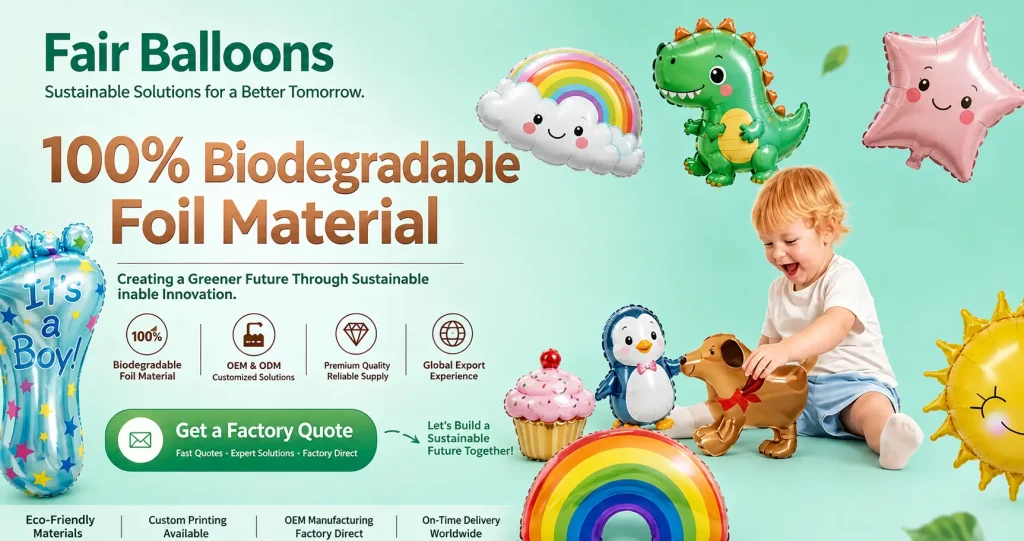

For global brand managers, licensed IP curators, and wholesale distributors, sourcing custom shape foil balloons or specialized custom cartoon balloons is a highly lucrative but technically complex endeavor [3, 4]. Symmetrical catalog items like stars or rounds distribute pressure uniformly across seams [1:8], but translating an irregular corporate mascot or licensed animated character into high-buoyancy mylar foil balloons requires precise physics, chemistry, and geometric mechanics [3].
Many importers suffer critical supply chain bottlenecks—such as structural distortion upon inflation, slow helium seepage, or seam bursting at high altitudes—due to a fundamental misunderstanding of flat material behaviors [3, 4]. Operating advanced high-barrier production lines in Jiangsu, China since 2007 [3], Kunshan Fair Craft Products Co., Ltd. (FAIR) has compiled this industrial customization blueprint [3]. We explain how we deploy precision 3D CAD modeling, multi-axial stress compensation, and precision alloy mold carving to deliver flawless, zero-defect custom production runs [3, 13, 2:24].
| Customization Metric | B2B Sourcing Specification & Standard | Engineering Significance for Importers |
|---|---|---|
| Custom Mold Tooling Fee | Compensated / waived once the contract MOQ threshold is satisfied [14] | Lowers capitalization risks for multi-character seasonal releases [14] |
| Design Compatibility | Vector files (AI, CDR, CAD, PDF) with maximum flat dimension marks [11] | Ensures rapid conversion to stress-simulated 3D models [11] |
| Leak Testing Protocol | 100% inflation pressure test for 24 to 48 hours [13, 16] | Eliminates micro-leakage and Amazon negative reviews [16] |
| Built-in Valve System | 18cm single-flap non-return self-sealing valve [15] | Delivers 15+ days of helium flotation retention [15] |
| Raw Material Base | High-density biaxially-oriented Nylon (BOPA) / PE barrier laminates [50, 77] | Exceptional flex-crack resistance and puncture proofing [50] |
Foil balloons are fundamentally manufactured by heat-pressing and welding two flat sheets of plastic-aluminum composite film together [50]. Unlike latex, which is highly elastic and stretches evenly, metallized substrates (commonly known as Mylar) are virtually inelastic [7]. Once pressurized with helium (He) or air, the flat 2D film struggles to expand, pulling the edges dramatically inward toward the central geometric axis [7].
This inward pull triggers severe geometric distortion. If a customer provides a standard 3D rendering (post-inflation state) and a factory copies it directly onto flat film, the resulting balloon deforms. Irregular limbs (like cartoon ears, tails, or spikes) will either fail to inflate entirely or burst under stress concentration [7]. At FAIR, our R&D team recalculates the "flat pattern shrinkage compensation"—warping the flat 2D layout mathematically so that, once inflated, the physical film contracts into the precise, ideal 3D proportions requested by the brand [3, 7].
Beyond visual layout, irregular boundaries generate highly uneven stress vectors along the welded seams [8]. Symmetrical forms like classic geometric star foil balloons and 18-inch standard round balloons distribute stress cleanly [3, 8]. In contrast, complex mascot shapes require integrated compression line routing and micro-airflow channels to allow smooth inflation circulation while safeguarding the integrity of our built-in 18cm self-sealing valve [15].
At FAIR, we have engineered out the uncertainties of bespoke manufacturing [3]. Every custom shape project—whether producing bulk custom cartoon balloons, licensed 3D shape lines, or giant corporate logos—follows our standardized 6-step workflow [3, 11, 13]:
Buyer provides clean, flat vector files (AI, CDR, or high-res PDF) with precise pre-inflation flat dimensions marked [11].
Engineers run computer-aided stress tests on sharp angles, valve lines, and seam stresses, providing mold fee quotes [12].
R&D technicians craft a physical pre-production sample on a high-frequency machine, subjecting it to a 24H leak test [3, 13].
Following client sign-off, we carve high-precision alloy heat-cut molds and engrave gravure steel printing cylinders [14].
Multi-color high-speed presses run ECHA/EN71 food-grade inks under automated photoelectric micron-precision control [15, 51].
Every piece undergoes automated pressure auditing to ensure absolute quality before secure export boxing [16, 46].
This systematic validation ensures that the final mass-produced product operates exactly like the confirmed prototype [13]. For complex retail deployments—such as customized birthday themes or holiday programs—buyers can cross-reference our guide to foil balloon types to coordinate accessory packaging.
Working with inexperienced trading brokers or non-standard workshops often leads to catastrophic supply chain failures [46]. Below are the most common custom-molding failures and how FAIR resolves them:
Problem 1: Cartoon Mascots Distorting Severely Post-Inflation
Root Cause: Standard graphic designers lay out flat files without accounting for film shrinkage coefficients [14]. When inflated, circular details warp, and limbs twist inward [7].
FAIR Solution: We provide free 3D-to-2D pre-production analysis [11, 14]. Our team modifies the flat artwork lines, ensuring the physical balloon blossoms into the perfect proportions of your IP mascot [7, 14].
Problem 2: Corner Cracking and Seam Bursting
Root Cause: Sharp corners or tight angles create high stress-concentration focal points. During inflation, these areas fail under pressure [8].
FAIR Solution: We implement a minimum corner curvature radius standard. Our CNC software automatically rounds off sharp, structural corners, redistributing the internal pressure cleanly without compromising the design [14, 15].
Problem 3: Prohibitive Mold Tooling Fees for Trial runs
Root Cause: Heavy machinery setup and rotogravure cylinder engraving require high initial investments [14, 46].
FAIR Solution: For small brands or retail tests, we offer flexible low-MOQ digital printing customization [20]. Importers can execute a 500-unit trial with screen or digital processes first [20]. Once market viability is confirmed, we transition to rotogravure and high-speed CNC mold carving for large-scale production, amortizing initial capital outlays [14, 20].
For corporate entities and e-commerce Amazon sellers, international trade is governed by rigorous chemical and safety regulations [3, 13, 46]. Importing uncertified products leads to heavy fines, legal liabilities, and store removals [26, 46].
At FAIR, we provide full-chain compliance guarantees to safeguard your import pipeline [16, 46]:
- SGS RoHS Heavy-Metal Free Testing: Our surface inks, co-extruded films, and built-in valves perfectly pass EU RoHS 2.0 and ECHA REACH requirements, certifying zero content of restricted phthalates, lead, or cadmium [56]. Explore our verified chemical audits in the SGS RoHS compliance center.
- EN71 & CE Safety Compliance: Our custom shapes are thoroughly verified for physical flammability, seam tear strength, and mechanical safety under EN71 Part 3 and CE Toy Safety Directives [57]. Check our EN71 toy safety guide and CE European compliance registry for official B2B documentation.
- Environmental ESG Alignment: We are a registered member of the Pro Environment Balloon Alliance (PEBA) since 2019 [65]. For forward-looking brands, we offer plant-based compostable options under our specialized R&D center. Importers can study these eco innovations in our certified biodegradable balloon manufacturer report or study the breakdown timeline in our biodegradable Mylar technology guide.
Custom Shaped Balloon Customization FAQs
Standard designers draw the balloon in standard 3D rendering (the post-inflation ideal form) [7]. However, because polymer films are inelastic, inflation triggers a multiaxial inward stress causing the flat surface to contract towards the center [7]. Without mathematical "flat pattern shrinkage compensation" calculated by factory engineers, regular geometries warp, and ears, limbs, or corners distort or burst under pressure [7, 8].
The 10,000-unit threshold amortizes the high-precision CNC engraving cost of custom aluminum alloy mold plates and the rotogravure steel cylinders used for multi-color printing [14]. For smaller-scale market tests, we provide low MOQ flexible digital printing customization paths under 500 units to reduce development overhead [20].
Our handmade prototype samples are crafted piece-by-piece by senior R&D technicians using high-frequency heat-sealing tables with the exact co-extruded Nylon/PE composite film and valve components of mass production [13]. This allows 100% accurate physical testing of shape, float buoyancy, and seal integrity before carving costly automated steel molds [13, 14]. Mass production is subsequently managed by automated assembly lines to guarantee absolute consistency [15].
Industrial References & Regulatory Citations
- Single-Use Plastics Directive (EU) 2019/904 - Standardized policy guidelines on environmental packaging and plastic control.
- SGS Physical Mechanical Test Report SHMR220700361301 - High-barrier polymer co-extrusion tear strength and tensile evaluations.
- Kunshan Fair Craft Products Co., Ltd. (FAIR) OEM Custom Tooling Handbook (2026) - CNC molding, flat pattern deformation calculations, and heat-sealing parameters.
- SGS RoHS Chemical Safety Certification SHAHG2207652301 - Heavy metal, benzene-free, and phthalate residue analysis for printed polyamide packaging.
- Pro Environment Balloon Alliance (PEBA) B2B Supply Chain Code of Practice (2019-2026) - Responsible commercial balloon manufacture and activation guidelines.
Request a Free Technical Feasibility & Sourcing Quote
Convert your brand mascots or proprietary cartoon designs into high-performance, leak-free custom foil balloons. Submit your 2D vector files to FAIR's engineering division for a free feasibility report and direct ex-factory pricing.
Submit Your Design Artwork →