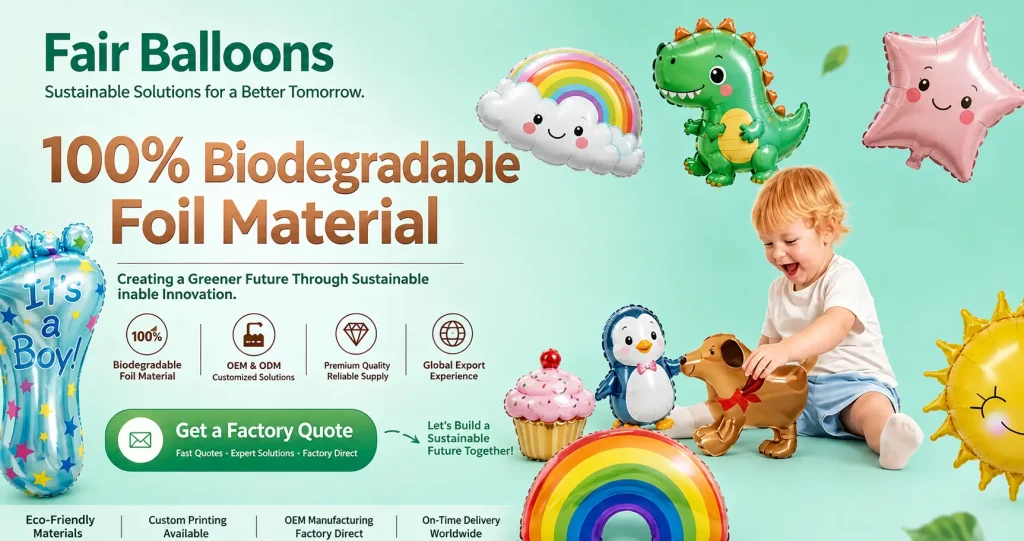

For global retail syndicate managers, professional event decorators, and promotional category procurement officers, sourcing mylar foil balloons is a multi-dimensional engineering challenge [3]. In nationwide brand activations and bulk retail supply chains, minor technical defects—such as faulty self-sealing check valves, inaccurate print registration, or microscopic pinhole leaks—can lead to catastrophic campaign failures and wasted marketing investments [3, 7].
Understanding the core physics of gas retention, the differences in polymer chemical matrices, and the regulatory compliances required for import clearance is the foundation of smart sourcing. This Top 40 Foil Balloon Sourcing FAQ serves as your technical handbook, curated by our R&D team to address every core metric from helium thermodynamics to custom OEM tooling fees [3].
A foil balloon (also referred to as a Mylar balloon or aluminum balloon) is an inflatable gas-retention display made from a high-performance multi-layer co-extruded composite film [3].
At the core of premium commercial balloons, the sheet consists of a micro-thin physical vapor deposited (PVD) aluminum layer laminated between a structural Biaxially-Oriented Polyamide (BOPA/Nylon) gas-retention core and a flexible Linear Low-Density Polyethylene (LLDPE) inner sealant layer [3]. This specific multi-tier architecture blocks single-atom helium diffusion, allowing the balloon to float comfortably for 5 to 7 days or longer under standard ambient parameters [3].
The core difference is rooted in material chemistry, porosity, and gas retention [3, 7]:
- Material Base: Foil balloons utilize multi-layer metallized polymer composites. Latex balloons are manufactured from natural rubber tree sap (elastomers).
- Permeability Rate: Latex rubber is highly porous at the molecular level. Monatomic helium atoms (radius 0.14nm) quickly migrate through the amorphous gaps, causing latex balloons to lose buoyancy in 8 to 12 hours. Foil balloons use tight, hydrogen-bonded polyamide meshes, ensuring premium helium float times of 5-7 days.
- Applications: Latex is elastic and suitable for quick, short-term displays. Foil balloons support intricate custom printing, complex 3D shapes (like star foil balloons and foil heart balloons), and are highly reusable.
In standard commercial trade, "foil balloon" and "Mylar balloon" are used interchangeably to describe reflective, metallic-coated balloons [3]. However, from an engineering standpoint, "Mylar" is a registered trademark of DuPont for Biaxially-Oriented Polyethylene Terephthalate (BOPET) film.
While low-cost, disposable retail toy balloons are often constructed from cheap BOPET (metallized polyester), high-float commercial displays use Biaxially-Oriented Polyamide (BOPA/Nylon) co-extruded matrices [3, 7]. Nylon composite film offers up to 5x higher helium barrier protection and excellent flex-crack resistance during shipping. Review our full complete guide to foil balloon types for technical material breakdowns.
A standard 18-inch foil balloon filled with high-purity helium floats for 3 to 7 days under controlled indoor conditions. High-barrier Nylon/PE composites can maintain buoyancy for 7 to 14 days [3, 7].
Key variables affecting float time:
- Thermal Exposure: Heat accelerates monatomic kinetic energy, causing helium to expand and permeate through the film matrix faster. Keep balloons away from direct summer sunlight and heating vents.
- Seam Welding Integrity: Micro-fractures along heat-welded borders act as escape vents. Quality control must measure seam width precisely to withstand gas pressure.
- Inflation Volume: Underinflating reduces total gas capacity, meaning the balloon will reach its negative-buoyancy limit sooner.
Foil balloons produced by certified manufacturers like FAIR are completely non-toxic and safe for children's events [5]. All raw materials, ink pigments, and adhesives comply with Europe's EN 71 Part 3 (heavy metal migration limits), US ASTM F963 (toy safety standard), and global RoHS directives [5].
Importers must advise end-users on three hazards: 1) Choking hazard for children under 8 from uninflated or torn balloon fragments; 2) Electrical conductivity of aluminum-coated films (must be weighted to prevent contact with power lines); 3) Extreme heat melting risks near open fire pits or birthday cake candles.
Foil balloon sizing ranges from small decorative inserts to massive outdoor displays:
- Mini Formats (4", 9", 14"): Designed exclusively for air-fill. Due to their small gas capacity, their self-weight is higher than their helium displacement lift. Used as hand-out giveaways or floral inserts.
- Standard Celebration Sizes (18" Rounds, Stars, Hearts): The most popular retail formats, designed for helium float or air garlands.
- Jumbo Display Formats (32", 34", 40"): Giant letters (foil letter balloons) and numbers (foil number balloons) optimized for milestone celebrations, graduation displays, and corporate backdrops.
To ensure seam integrity and valve reliability, follow our factory-calibrated step-by-step process [3]:
- Operate in a temperate workspace (18-24°C / 65-75°F) with clean, grease-free hands [3].
- Lay the balloon flat and inspect the perimeter for any transit creasing or seam damage.
- Locate the self-sealing check valve tab, usually located along the bottom neck.
- Insert the helium nozzle gently at least 1 inch (2.5 cm) into the internal pocket to bypass the initial check flap.
- Inflate slowly. Stop when the main body is smooth, showing slight, soft wrinkles along the heat-welded edges.
- Withdraw the inflation tip smoothly; press the neck flat to seal the pressure-sensitive valve.
Yes, foil balloons can be filled with air using a manual hand pump, electric balloon pump, or standard compressor lines. While air-filled balloons do not float, they are highly stable:
- Lifespan: Because air (mostly Nitrogen and Oxygen) has much larger molecular radii than helium, it cannot diffuse through the polymer film easily, allowing air-filled displays to remain plump for 2 to 4 weeks.
- Retail Integration: Ideal for balloon garlands, table centerpieces, and promotional mylar balloons on a stick.
Because Nylon/PE composites are highly robust, foil balloons can be deflated, flat-packed, and re-inflated multiple times:
- Gently slide a long, thin straw (at least 6-8 inches) into the self-sealing check valve until you feel the inner flap release.
- Press the balloon body flat with open palms to evacuate the internal gas.
- Fold the deflated balloon flat, avoiding sharp hard creases that could damage the vapor-deposited aluminum barrier.
- Store flat in a dry, cool space away from direct UV light and sharp objects.
Premature deflation is typically caused by:
- Thermal Contraction: Cold environments cause helium molecules to slow down and contract, making the balloon look instantly saggy. This is a reversible physical phenomenon—moving the balloon back to room temperature will restore full inflation.
- Seam Stress / Overinflation: Inflating past the recommended pressure threshold creates micro-fractures in the polyethylene sealant weld.
- Crease Damage: Cheap polyester (BOPET) films are prone to permanent creased folds ("dead folds") which crack the metallic gas barrier. Our Nylon (BOPA) cores eliminate this issue. Learn more in our structural air leakage prevention guide.
The self-sealing check valve is an automated seal mechanism built directly into the balloon's inflation neck [3]. It consists of two layers of highly flexible, non-stick polyethylene film heat-fused at offset intervals [3].
During inflation, the high-pressure gas from the nozzle separates the two film layers, creating a channel to fill the balloon cavity [3]. Upon withdrawing the nozzle, the internal gas pressure of the balloon presses the two flexible film flaps firmly against one another [3]. This pressure-sensitive seal closes the valve channel automatically, eliminating the need for manual heat-sealing, strings, or knots [3]. Read about this in detail in our self-sealing valve technical breakdown.
Helium requirements scale cubically with dimensions. Refer to our B2B volume guide below:
- Standard 18" Round/Shape: Requires approximately 0.5 cubic feet (14.1 Liters) of gas, yielding 10-15g of lift capacity.
- Jumbo 34" Digit/Shape: Requires approximately 1.5 to 1.8 cubic feet (42.5 to 51 Liters) of gas, yielding 40-50g of lift capacity.
- Super-Jumbo 40" Letter/Number: Requires approximately 2.2 to 2.5 cubic feet (62.3 to 70.8 Liters) of gas, yielding 60-85g of lift capacity.
Foil balloons must be filled with a gas lighter than the ambient air (such as helium) to float naturally. There is no alternative gas that is both safe and effective (hydrogen is highly flammable).
However, B2B buyers can deploy excellent helium-free display alternatives:
- Air-Filled Structural Displays: Using framing rods, column stands, or hanging lines to suspend air-filled balloons.
- Self-Inflating Mini Sticks: Compact self inflating foil balloons that inflate on-demand via a citric acid/baking soda capsule, mounted on plastic poles.
- Balloon Garlands: Modern organic arches constructed completely with air-filled, standard shape foils.
Helium supply is divided into two procurement channels:
- Small-Scale/Retail: Disposable, light-weight helium canisters containing 8.9 to 14.9 cubic feet of gas can be sourced at party supply stores or online.
- Enterprise-Scale B2B: High-pressure steel cylinders (T-tanks, 200-300 cu ft) can be leased or refilled through local industrial gas suppliers.
Given ongoing helium scarcity and price volatility, procurement managers should coordinate gas supply contracts locally alongside their balloon shipments [7].
Yes, helium is completely safe and inert [5]. It is a non-toxic, non-flammable noble gas that poses zero chemical or fire risks during event setup or transport [5].
Important Health Warning: Helium must never be inhaled deliberately. Breathing pure helium displaces oxygen in the lungs, leading to rapid asphyxiation, dizziness, brain damage, or fatal loss of consciousness. Educate event staff to prevent this practice at all times.
This is down to the difference in Gas Transmission Rates (GTR) of the balloon materials:
- Latex: Latex is an elastomer with a highly open, porous molecular structure. Helium atoms slip through the natural rubber chains easily, leading to deflation within 12 hours.
- Nylon/PE Foil: Biaxially-oriented Nylon (BOPA) has a highly crystalline molecular density stabilized by polar hydrogen bonds. When coated with vapor-deposited aluminum, the composite sheet achieves a helium transmission rate that is up to 100 times lower than latex.
This physical difference allows a Nylon foil balloon to float for over a week, while latex balloons require chemical "hi-float" treatment to survive past 24 hours. Learn more in our Nylon vs Polyester Helium Barrier Study.
While completely non-toxic, foil balloons present physical safety risks if unmonitored:
- Choking: Deflated or ruptured balloon fragments can easily block a young child's airway. Keep uninflated stock locked away.
- Entanglement: Long decorative ribbons or cords can wrap around a child's neck. All commercial display strings must be wind-rated and kept under standard length limits.
- Suffocation: Putting large-format balloons over the head must be strictly prevented.
Aluminum-coated foil balloons are highly conductive. If a metallic balloon escapes and contacts high-voltage power lines, do NOT attempt to dislodge it yourself with poles, sticks, or any equipment. Doing so can trigger a high-voltage arc, leading to severe electrical burns or electrocution. Stay at least 30 feet away and report the incident immediately to your local power utility.
Yes, there are strict international laws and municipal bans regulating or prohibiting the release of foil balloons outdoors:
- United States: States like California, Florida, and Virginia enforce strict penalties and require foil balloons to be weighted during retail sales to prevent escape into power lines.
- Europe & Australia: Large-scale balloon releases are widely illegal due to the environmental risk of plastic litter in marine and forest habitats.
- B2B Strategy: Sourcing managers should align with the Pro Environment Balloon Alliance (PEBA) guidelines, advocating the "Pin It & Bin It" policy—always tethering balloons to weights and disposing of them responsibly. Refer to our PEBA Alliance Member Guide.
To prevent custom seizures and liability claims, ensure your manufacturer holds current, verified certifications [5]:
- EN 71 Part 1, 2, 3: European Toy Safety Standard (mandatory for EU customs clearance) [5]. Check our EN71 Toy Safety Guide.
- ASTM F963 / CPSIA: US Consumer Product Safety standard (mandatory for US retail) [5].
- SGS RoHS: Verifies complete elimination of heavy metals and phthalates [5]. Review our SGS RoHS Report Portal.
- CE / REACH: European Union market access conformity. Review our CE Europe Compliance center.
Standard polymer films do not spontaneously ignite, but they present burn hazards in specific circumstances:
- Solar Refraction: The high-gloss, metallic silver mirror layer of cheap balloons can refract and concentrate sunlight. If placed near dry brush or highly reflective glass surfaces under intense heat, they can act as a parabolic mirror.
- Open Flames: Polyethylene and Nylon films will quickly melt, warp, or drip if placed near open birthday candles, fire pits, or heaters.
Traditional foil balloons are made from non-biodegradable petroleum-derived substrates (BOPET and Polyethylene) that can take hundreds of years to decompose in landfill environments.
To mitigate this, responsible B2B buyers are transitioning their stock portfolios to next-generation bioplastics (such as polylactic acid co-extruded films) that achieve complete industrial composting without sacrificing helium lock performance.
Yes, foil balloons are technically recyclable because they contain valuable aluminum. However, standard municipal recycling plants cannot process them:
- The Separation Challenge: The polymer matrix (Nylon/PE) is chemically bonded to the aluminum layer. Standard machinery cannot separate these layers easily.
- Alternative Solution: Work with specialized industrial plastic recycling centers or Terracycle programs that accept post-consumer composite films, or focus on reusing the balloons multiple times.
True biodegradable foil balloons are constructed from specialized biopolymer blends, specifically PLA-PBAT-nanoclay films [2].
Unlike traditional plastics, these advanced materials have been verified by SGS Composting Certificate SHMR220700361301 to break down completely in industrial composting facilities within 180 days conforming to European standard EN 13432 and US ASTM D6400 [5]. They offer identical 5-7 days float times but zero microplastic residue. Read our certified biodegradable balloon manufacturer report or study the chemistry in our PLA-PBAT technology guide.
Each material presents distinct environmental profiles:
- Latex: Made from natural tree sap, latex is 100% biodegradable in nature within 6 months to 2 years. However, latex is single-use and cannot be deflated or reused.
- Foil: Non-biodegradable (unless certified compostable PLA), but has superb mechanical durability. A single premium foil balloon can be deflated and re-inflated dozens of times, potentially reducing the total unit footprint of a multi-week campaign.
At FAIR, our green innovation roadmap is centered on three engineering tracks [3]:
- Developing compostable films from renewable agricultural starches meeting ASTM D6400 [2].
- Transitioning printing lines from solvent-based inks to water-based, volatile organic compound (VOC)-free pigments [3].
- Optimizing film extrusion thickness down to 25 microns while improving molecular density, reducing material volume by 22%.
Yes, direct manufacturers offer complete OEM/ODM custom printing services for corporate branding [3]. Artwork can be reproduced across standard rounds, stars, hearts, or custom shapes using three print technologies [3]:
- Rotogravure Printing: High-speed copper cylinders, best for massive runs (MOQ 10,000+ pcs) with perfect color registration [3].
- Flexographic Printing: Flexible photopolymer plates, cost-effective for medium runs (1,000 to 5,000 pcs).
- High-Definition Digital Printing: No print plates, allowing low MOQ (300-500 pcs) for short campaigns. Review our custom printed Mylar balloon oem handbook.
MOQs are governed by the custom setup requirements of the printing and cutting equipment [3]:
- Standard Shape Custom Printing: MOQs start at 500 to 1,000 pieces per design for screen/digital printing.
- Bespoke Custom Shapes (Mascots/Replicas): MOQs start at 10,000+ pieces per design to amortize the high-precision CNC alloy mold carving costs [3]. See our shaped foil balloons OEM portal for detail.
The typical end-to-end B2B manufacturing timeline is 3 to 6 weeks [3]:
- Artwork Verification & Proofing: 3-5 business days [3].
- CNC Mold Engraving (for custom shapes): 2-3 weeks [3].
- High-Speed Rotogravure Printing: 1-2 weeks depending on batch volume.
- 48-Hour QC Leak Testing: 2 days in climate-controlled QA bays [7].
- Transit: Air freight (5-7 days) or ocean shipping (3-5 weeks).
To prevent resolution loss and ensure perfect print registration, provide artwork matching our pre-production matrix:
- Vector Formats: Adobe Illustrator (AI), EPS, or vector PDF with all text converted to outlines.
- Resolution: High-resolution raster elements must be at least 300 DPI.
- Color Space: CMYK color model with precise Pantone (PMS) color codes provided for exact brand matching.
- Bleed Margin: Include at least 3-5mm bleed margins along outer die-cut lines.
Learn more in our foil balloon printing methods guide.
Yes, reputable factories always recommend pre-production physical samples:
- Stock Samples: Free-of-charge samples from previous production runs are available to verify film thickness, heat-sealing quality, and valve function.
- Custom Prototype Samples: Range from $100 to $300 to cover setup costs, which are fully credited back to the buyer upon executing the bulk order contract.
B2B wholesale pricing scales with order volume and material composition:
- Standard 18" Rounds/Shapes (Bulk): Range from $0.15 to $0.45 per piece (FOB China) for bulk volume importers [3].
- Custom Printed 18" Rounds: Range from $0.25 to $0.80 per piece depending on the number of colors [3].
- Giant 34-40" Digit/Letter Balloons: Range from $0.80 to $2.50 per piece on wholesale terms.
Key cost factors include the polymer substrate (Nylon vs. cheap PET), printing plate complexity, packaging requirements, and total order volume.
Verify these seven indicators before selecting a manufacturing partner [3, 7]:
- Seam Width Consistency: The heat-sealed border must be uniform, with no thin points or overlapping melt channels.
- Check Valve Stability: The valve tab must insert smoothly and seal instantly upon nozzle removal without manual tape.
- Substrate Flexibility: Pressing the inflated balloon should feel soft and elastic (indicates a robust BOPA/Nylon core) rather than stiff and crinkly (indicates a low-cost, brittle BOPET film).
- Print Registration: Color boundaries must be crisp, with no overlap, ink voids, or flaking.
- Purity Certifications: Display clear safety markings (CE, EN71, ASTM).
- Automated Leak Monitoring: A strict factory quality assurance bay using automated optical inspection (AOI) to keep defect rates below 0.3% [7]. Explore this in our foil balloon quality control system portal.
For party planners, retail chain procurement managers, and marketing agencies, purchasing bulk mylar balloons or bulk foil balloons directly from a primary manufacturer like FAIR offers significant business advantages:
- Margin Optimization: Bypassing distributor networks yields a 40% to 60% reduction in unit land costs.
- Design Autonomy: Access to custom CAD modeling, private brand labels, and exclusive packaging formats.
- Supply Security: Direct engineering oversight, custom color matching, and priority production scheduling for seasonal spikes.
Based on international market trends, B2B inventory managers should focus on three high-growth product groups:
- 3D Spherical Orbz (balloon orbz): True spherical balloons that provide a smooth, wrinkle-free metallic mirror look, highly popular in luxury event design.
- Self-Inflating Mini Sticks (self inflating foil balloons): Small format balloons on sticks, excellent for checkout counter retail placement.
- Airwalker Balloons (airwalkers balloons): Giant character displays with weighted bases that float and walk organically along the ground. Check our complete guide to foil balloon types for a detailed B2B product breakdown.
The best place to buy foil balloons online depends entirely on your business volume:
- For small-scale party planners or one-off events, consumer platforms like Amazon or local distributors are suitable.
- For distributors, regional wholesalers, and corporate procurement teams seeking custom branding or container-level pricing, sourcing direct from manufacturer websites like foilballoon.cn offers the best price-to-quality ratio, technical supervision, and chemical safety guarantees.
Launching a professional balloon decoration business requires:
- Identifying your target niche (luxury weddings, corporate galas, shopping mall installations).
- Sourcing high-quality, certified balloons with EN 71 and ASTM F963 safety markings to protect your business reputation.
- Investing in professional inflation gear (pressure-calibrated gas regulators, high-pressure helium cylinders, electric air pumps).
- Building a visually cohesive online portfolio and establishing strong direct-factory relationships to secure wholesale margins.
For international wholesale orders, standard payment and logistics structures include:
- Payment Terms: T/T Bank Transfer (typically a 30-50% deposit to initiate custom raw material extrusion, with the balance cleared prior to container dispatch), or Letter of Credit (L/C) for large enterprise shipments.
- Shipping Methods: Sea freight (most cost-effective for large pallet shipments, taking 3-5 weeks depending on the destination port); Air freight (faster, 5-10 days, for urgent seasonal campaigns); Express Courier (DHL/FedEx, 3-7 days, primarily used for physical sample approvals).
Yes, some manufacturers support dropshipping for established e-commerce retailers:
- Operational Advantages: Eliminates your warehouse holding costs and inventory risk; orders are packaged neutrally and dispatched directly from the factory line to the consumer.
- Key Quality Check: Ensure your manufacturer has real-time inventory API tracking and maintains standard packaging quality so dropshipped retail orders arrive without transit creasing.
Exporting foil balloons internationally requires strict compliance with international custom codes:
- HS Tariff Classification: Balloons are categorized under HS Code 9503.00 (toys and festive novelties).
- Customs Documentation: Shipments must be accompanied by a clean Commercial Invoice, detailed Packing List, Bill of Lading, and a Certificate of Origin.
- Safety Testing Compliance: Customs officials at European or US ports regularly audit shipments for chemical safety. Ensure your manufacturer provides third-party SGS test reports proving compliance with REACH, RoHS, and CPSIA [5].
Industrial References & Regulatory Citations
- European Parliament & Council Directive (EU) 2019/904 - Single-Use Plastics Directive on the reduction of environmental plastic waste.
- SGS Laboratory Test Report SHMR220700361301 - Evaluation of PLA-PBAT biodegradable composite films under EN 13432 composting standards.
- Kunshan Fair Craft Products Co., Ltd. (FAIR) OEM Materials Handbook (2026) - Co-extrusion film lamination, self-sealing check valve physics, and rotogravure parameters.
- SGS RoHS Chemical Safety Report SHAHG2207652301 - Heavy metal and phthalate analysis of printed polyamide films.
- Pro Environment Balloon Alliance (PEBA) B2B Supply Chain Code of Conduct - Responsible commercial balloon deployment and waste management guidelines.
Request an Enterprise Compliance & Sample Portfolio
Optimize your global sourcing programs with direct OEM/ODM agreements. Partner with Kunshan Fair Craft to receive custom CAD drawings, wholesale FOB price sheets, and certified SGS test packages.
Contact Our Sourcing Engineers →