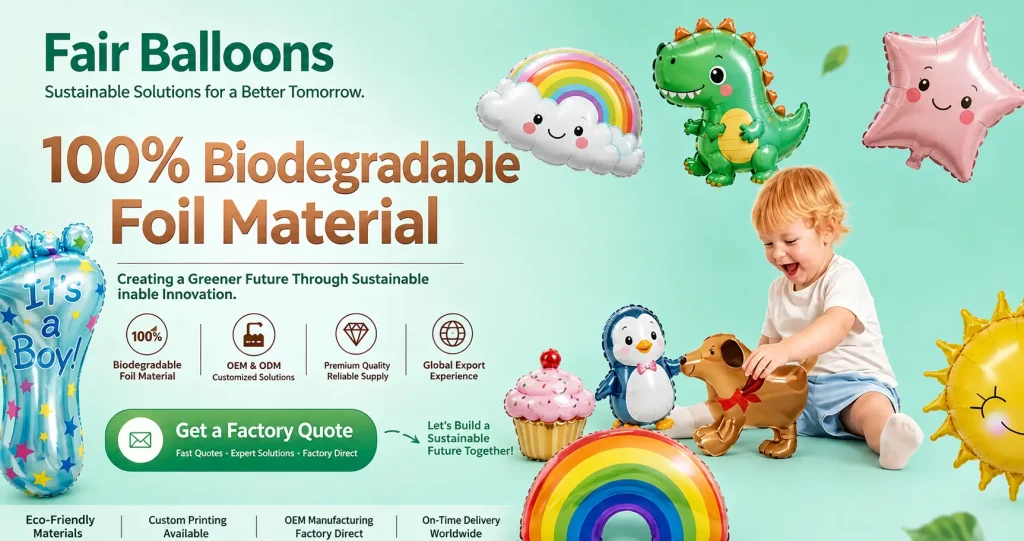
Biodegradable foil balloons banner showcasing eco friendly mylar balloons material at official balloon factory china.
18 Inch Standard Round Foil Balloons | Mylar Balloons Complete Expert Guide
⭐ Ultimate Buyer's Guide 2026

18 Inch Standard Round Foil Balloons & Mylar Balloons: Everything You Need to Know

The complete technical and commercial guide to 18" standard round foil balloons (mylar balloons) — specs, filling methods, customization, safety, and sourcing tips used by wholesalers and event professionals worldwide.

18 Inch Standard Round Foil Balloons — interchangeably called mylar balloons — are the single most versatile and widely sourced decorative balloon format in the global party supplies market. Whether you are a wholesale distributor, event planner, Amazon seller, or brand manager, understanding the technical details behind this deceptively simple product will save you money, prevent costly mistakes, and help you source better quality. This guide covers every aspect of the 18" round foil balloon from material science to procurement, filling, and safety.

What Is a Foil Balloon? The Definitive Answer

A foil balloon is a decorative inflatable made from a thin, metallized polyester film — commonly referred to by its brand name mylar balloon — that is heat-sealed into a bladder shape and equipped with a self-sealing valve. The defining characteristics of foil balloons are their mirror-like metallic sheen, their non-porous surface, and their significantly longer helium and air retention compared to latex balloons.

The outer shell of a foil balloon is not actually "foil" (aluminum foil sheet) but rather a metallized biaxially-oriented polyethylene terephthalate film (BoPET). This material is vacuum-coated with a microscopic layer of aluminum atoms, which gives it the reflective, metallic appearance that consumers colloquially call "foil." The result is a material that is lightweight, printable, durable, and chemically stable — far superior to traditional aluminum foil for balloon applications.

How Foil Balloons Are Manufactured: A Step-by-Step Process

  1. PET Film Extrusion: Polyester resin is extruded into thin sheets (typically 10–15 μm thick) through a flat-die extrusion process. The film is then biaxially stretched to align polymer chains for optimal tensile strength.
  2. Vacuum Metallization: The PET film passes through a vacuum chamber where aluminum is vapor-deposited onto its surface in a layer approximately 30–50 nanometers thick. This creates the reflective metallic coating while maintaining the film's flexibility.
  3. Printing: Designs are applied using rotogravure (for high-volume commercial runs), flexographic (for bold solid colors), or digital printing (for small custom orders). All inks used in quality factories are solvent-free and comply with EN71 and ASTM D-4236 standards.
  4. Heat Sealing (Welding): Two sheets of printed metallized film are laid together and heat-sealed along the balloon's perimeter and center seam. This is the most critical manufacturing step — the seal must withstand internal pressure without delaminating. Factory-grade balloons use servo-controlled heat-sealing with ±1°C precision.
  5. Valve Insertion: A self-sealing silicone valve is installed in the balloon's inflation neck. The valve allows air or helium to pass in but seals automatically when the inflation source is removed.
  6. Leak Testing: Every balloon is tested for hermetic seal integrity. Premium factories use 100% automated helium leak detection with sensitivity of 1×10⁻⁹ Pa·m³/s.
  7. Folding & Packaging: Balloons are carefully folded, placed in anti-static polybags, and packed for shipping to prevent surface scratching during transit.
Modern foil balloon factory production line showing heat-sealing equipment and quality inspection stations with automated leak detection

Factory-grade foil balloon manufacturing: precision heat-sealing and automated 100% leak testing on a modern production line

Foil Balloon vs Mylar Balloon — What's the Actual Difference?

In practical terms, "foil balloon" and "mylar balloon" refer to the exact same product. The two terms arise from different perspectives:

  • "Mylar" is a brand name — specifically a registered trademark owned by DuPont Teijin Films for their biaxially-oriented PET (BoPET) film. Like "Thermos" or "Band-Aid," the brand name became so widely used that it entered common vocabulary as a generic descriptor. When people say "mylar balloon," they mean any balloon made from metallized BoPET film.
  • "Foil balloon" is a descriptive term based on the visual appearance of the finished product — it looks like metallic foil. This is the consumer-facing term used in most retail marketplaces and search queries.
  • Actual aluminum foil balloons (made from rolled aluminum sheet) are virtually extinct in the consumer market. They were heavier, harder to print on, and more expensive to manufacture. The metallized PET film replaced them entirely about 30 years ago.
For SEO and content targeting: "foil balloons" has approximately 3–4× higher monthly search volume than "mylar balloons" in Google Trends data. When optimizing content, lead with "foil balloons" as the primary keyword and use "mylar balloons" as a secondary keyword in headings and body text. Both terms should appear naturally in the first 100 words of your article.

Why Mylar (BoPET) Film Won Over Aluminum Foil

The transition from aluminum foil to metallized BoPET film in balloon manufacturing was driven by four fundamental material advantages:

  1. Weight: BoPET film weighs approximately 10× less than equivalent aluminum foil at the same thickness, allowing balloons to actually float with helium.
  2. Printability: PET film accepts ink far better than aluminum, enabling high-resolution full-color printing.
  3. Sealability: Heat-sealing PET film produces consistent, strong welds. Aluminum foil is much harder to seal uniformly.
  4. Gas Barrier: While both materials provide helium barrier properties, the flexibility and durability of BoPET film makes it far more suitable for consumer handling.

18 Inch Standard Round Foil Balloon — Full Technical Specifications

The 18-inch round foil balloon is the most common size in the foil balloon category, accounting for roughly 35–45% of all foil balloon sales globally. Its universal appeal lies in its versatility — large enough for dramatic effect, compact enough for bouquets and arch work, and standardized enough for bulk procurement by retailers and event companies.

Specification Standard Value Premium / Factory Grade
Nominal Diameter (inflated)18 inches / 45.7 cm18 ± 0.3 inches (25°C, sea level)
Balloon ShapeStandard Round (circle)True circle verified by ball gauge template
MaterialMetallized PET filmBiaxially-oriented PET (BoPET), 12–15 μm
Film Thickness~10 μm (0.01mm)12–15 μm (heavier = higher burst resistance)
Net Weight (per balloon)6–9 grams8–10 grams (quality indicator)
Helium Capacity~1.5–2.0 cu ft (42–57 L)Validated by displacement measurement
Float Time (helium, standard)3–7 days7–14 days (high-barrier film)
Float Time (helium + Hi-Float)2–3 weeks3–4 weeks (with thick Hi-Float layer)
Air Capacity~1.2–1.5 cu ft (34–42 L)Same — air-filled balloons do not float
Recommended Inflation Pressure0.015–0.025 MPa0.018–0.022 MPa (never exceed 0.03 MPa)
Heat Seal Strength≥ 15 N/15mm≥ 20 N/15mm (factory-grade seam)
Burst Pressure> 0.06 MPa> 0.08 MPa (4× working pressure)
Operating Temperature–10°C to +45°C–15°C to +50°C (cold-sensitive)
Valve TypeSelf-sealing (built-in)Latex-free silicone valve, spring-loaded
Printable Area~360° circumference + top domeFull 360° rotogravure or digital
Individual PackagingPolybag (1 per bag)Anti-static sealed polybag
Shelf Life (uninflated)12–18 months18–24 months (sealed, dry storage)
RecyclablePET film — #1 recyclable100% recyclable where facilities exist
Size terminology note: "18 inch" refers to the balloon's diameter when inflated to the manufacturer's recommended pressure at standard temperature (25°C). The actual inflated size may be slightly smaller in cold environments and slightly larger in hot environments due to gas expansion (Charles's Law). Always inflate to the "firm but not rock-hard" standard — if the balloon feels hard, it is over-inflated.

Materials & Manufacturing Quality — Why Supplier Selection Is Critical

The performance gap between a cheap foil balloon and a premium mylar balloon is enormous and almost entirely determined by the quality of the underlying metallized PET film and the precision of the heat-sealing process. Understanding these variables empowers buyers to make smarter procurement decisions. See our factory-grade foil balloon manufacturing process →

The Science of Metallized PET Film for Balloons

Every foil balloon is built from a sandwich of functional layers, each contributing to performance:

🔬

PET Base Film

Polyethylene terephthalate provides structural integrity. Thicker gauge = higher burst resistance and better print surface quality.

Aluminum Metallizing

Vacuum-deposited aluminum (30–50 nm) creates the reflective surface and primary helium-barrier function.

🛡️

Barrier Coating

Premium films add SiOx (silicon oxide) coating for 2× extended helium retention vs. standard metallized film.

🎨

Eco-Solvent Inks

Phthalate-free, EN71-compliant water-based or eco-solvent inks. Never use balloons with不明油墨.

The Heat-Seal Quality Gap: Where Cheap Balloons Fail

The heat-seal — the welded seam that joins the two halves of the balloon — is the single most critical quality factor and the most common point of failure in budget balloons. The difference between factory-grade and budget heat-sealing: Learn about our factory-grade quality control and 100% leak-testing process →

  • Budget factories: Use single-point heat-press dies with manual temperature control. Temperature variance of ±5–10°C causes inconsistent seam strength. Seams may delaminate after 24–48 hours of helium inflation.
  • Factory-grade manufacturing: Uses servo-controlled continuous heat-sealing with real-time infrared temperature monitoring and dynamic pressure compensation. Precision of ±1°C. Seam strength ≥ 20 N/15mm with virtually zero delamination failures.

Film Gauge and Its Practical Impact

The thickness of the PET base film — measured in microns (μm) or "gauge" — directly affects three performance characteristics:

  1. Burst resistance: Thicker film = higher resistance to punctures and pressure spikes from temperature changes.
  2. Surface durability: Thicker film resists scratching and surface abrasion during handling and shipping.
  3. Print registration: Thicker film maintains dimensional stability during high-speed printing, resulting in sharper images and more accurate color matching.
Cross-section diagram of metallized PET foil balloon film showing aluminum coating, PET base layer, barrier coating, and ink layers

Cross-section of premium metallized PET foil balloon film: multiple functional layers that determine helium retention and durability

Helium vs Air: How to Fill 18 Inch Foil Balloons Correctly

Whether to fill an 18 inch foil balloon with helium or air is one of the most common sourcing and usage questions. The answer is not a matter of quality — it is a matter of application.

Helium vs Air: Side-by-Side Comparison

FactorHelium FillAir Fill
Does It Float?✓ Yes — 3–14 days typically✗ No — stays grounded
Best ApplicationsCeiling decor, bouquets, arches, floating displaysColumns, sculptures, table centerpieces, wall decor
Fill Cost$$ — helium tank rental or purchase$ — free (breath or hand pump)
Float Duration3–14 days (film quality dependent)Indefinite — no helium escape
Environmental Impact⚠️ Helium is finite/non-renewable✓ Reusable indefinitely, zero resource cost
Hi-Float Compatible?✓ Yes — extends to 2–4 weeks✗ Not applicable
Weight LimitFilm must be light enough to lift itselfNo weight limit when tethered
Refill FrequencyEvery 3–14 days depending on film qualityNever (unless valve fails)

Step-by-Step: Inflating an 18" Foil Balloon with Helium

  1. Remove from packaging: Take the balloon out and lay it flat. Do not force open the valve — the self-sealing valve is designed to open automatically when the inflation nozzle is inserted.
  2. Attach the nozzle: Push the balloon's valve stem firmly onto the helium tank nozzle or electric inflator adapter. Ensure a tight, leak-free connection.
  3. Inflate gradually: Open the valve slowly. Foil balloons fill faster than latex — stop when the balloon reaches approximately 90% of its rated size. It should feel firm but yield slightly under gentle pressure.
  4. Check the shape: A properly inflated 18" round balloon forms a near-perfect circle. Slight underinflation (leaving the balloon slightly smaller than 18") is intentional — it provides a buffer for thermal expansion on hot days.
  5. Seal and verify: Remove the nozzle — the self-sealing valve closes automatically. Hold the balloon with the opening pointing downward for 10 seconds to check for leaks.

Step-by-Step: Inflating an 18" Foil Balloon with Air

  1. Locate the valve: The self-sealing valve is the same for air and helium inflation — no difference in mechanism.
  2. Attach pump or inflator: Use a standard balloon hand pump, foot pump, or electric inflator with the appropriate adapter for foil balloon valves.
  3. Pump to firm: Pump until the balloon is firm to the touch and forms a true circle. Typically 30–60 pumps for a hand pump, or 5–10 seconds for an electric inflator.
  4. Seal automatically: Remove the pump — the valve seals on its own. Verify no immediate deflation.
Critical safety warning: Never over-inflate an 18" foil balloon. The recommended maximum inflation pressure is 0.03 MPa. Over-inflation from heat exposure or excessive helium volume is the leading cause of foil balloon ruptures. In direct sunlight, the internal gas pressure of a fully inflated balloon can increase by 20–30% — always leave headroom.

Hi-Float Gel: Extending Helium Float Time to 2–4 Weeks

Hi-Float is a water-based polymer gel that, when applied to the interior surface of a helium-filled balloon, creates a coating that dramatically slows helium molecule diffusion through the film walls. For the 18" round foil balloon:

  • Extends float time from ~5 days to approximately 2–4 weeks
  • Apply with the Hi-Float injection pump (included with Hi-Float product)
  • Allow Hi-Float to fully coat the interior surface (10–15 minutes) before adding helium
  • Hi-Float is non-toxic, water-soluble, and safe for use at children's events
  • Do not use Hi-Float in air-filled balloons — it provides no benefit
  • Note: Hi-Float adds a small amount of weight; test for adequate lift if using with printed custom balloons
Proper helium inflation of an 18 inch foil balloon using a pressure-regulated inflator with gauge showing correct pressure setting

Always use a pressure-regulated helium inflator — unregulated tanks can over-pressurize and burst foil balloons instantly

Custom Printing & Branding on 18 Inch Round Foil Balloons

Custom-printed mylar balloons are one of the highest-ROI promotional products available to businesses. The combination of a 360° printable cylindrical surface, vibrant metallic background colors, and the inherent visibility of inflated balloons creates a marketing vehicle that delivers brand exposure at events, retail locations, and in social media contexts.

Print Technologies for Foil Balloons

Print MethodBest ForColor RangeMOQ (Factory Grade)Setup Cost
Rotogravure (Roto)Photo-quality, high-volumeUp to 8 colors5,000+ units$$$ (printing cylinders)
FlexographicBold solid-color designsUp to 6 spot colors3,000+ units$$ (flexo plates)
Digital PrintingSmall runs, photographic detailFull CMYK + white500+ units$ (minimal)
Screen PrintingSimple logos, bold graphics1–4 spot colors1,000+ units$$ (screen meshes)

Critical Design Tip: Always Specify White Underprint

When printing on metallic BoPET film, the metallic surface color will mix with any printed ink color, producing results that differ significantly from the design on white paper. For accurate color reproduction, always specify a white underprint layer — a white coating applied between the metallic film and the printed design. Without this:

  • Light colors (pastels, white, skin tones) will appear tinted by the metallic base
  • Brand colors will shift unpredictably
  • Photographic images will lose contrast and appear "washed"

Popular Custom Applications

Explore our custom printed foil balloons and OEM balloon printing — MOQ from 500 pieces →

  • Corporate branding: Logo + brand colors for conferences, product launches, trade shows
  • Wedding monograms: Personalized names, dates, and elegant metallic color schemes in gold and silver
  • Birthday number balloons: Giant 18" numbers for milestone birthdays (18th, 21st, 30th, 40th, 50th)
  • Sports team fans: Team colors, mascots, and championship celebrations
  • Seasonal holidays: Christmas, Halloween, Valentine's, Easter in themed designs
  • Retail POP displays: Store openings, promotions, seasonal endcap displays
  • Political campaigns: Campaign colors and slogans for events and rallies

Non-Print Customization Options

  • Color-matched film: Metallic films beyond standard silver — gold, rose gold, copper, holographic, holographic prismatic, solid matte colors
  • Textured/embossed film: Raised patterns (crocodile, honeycomb, star) pressed into the film surface for premium tactile products
  • Die-cut shapes: Custom balloon silhouettes beyond the standard round shape
  • Fringe/tassel attachment: Factory-attached fringe trim for carnival and fiesta themes
For Amazon FBA sellers and major retailers: always confirm the factory's balloon safety certification (CE/EN71, ASTM D-4236, or regional equivalents) before finalizing your artwork. Products without proper certification will be removed from platforms like Amazon and Etsy, and may trigger customs holds at international borders.

Safety Standards & Certifications for Foil Balloons

Foil balloons are consumer products that come into direct contact with hands, skin, and are sometimes handled by children. The safety certifications attached to a factory's products are not bureaucratic paperwork — they are your legal and commercial protection as a buyer or retailer.

Why Safety Certification Matters for Every Buyer

Without proper safety certifications, your product is exposed to:

  • Platform removal: Amazon, Etsy, eBay, and major marketplaces require CE or ASTM D-4236 compliance for balloon products.
  • Customs seizure: International shipments without proper documentation are routinely held or destroyed at customs.
  • Legal liability: An un-certified balloon that causes injury carries full legal exposure.
  • Brand damage: A safety incident with your branded balloons is a PR disaster that no marketing can fix.

View our full CE, RoHS & EN71 test report documentation — downloadable PDFs →

Key Certifications Required for Foil Balloons

🇪🇺

CE Mark (EU)

Mandatory for EU market. Tests EN 71-1 (mechanical/physical), EN 71-2 (flammability), EN 71-3 (chemical migration). Issued by Notified Body.

🇺🇸

ASTM D-4236 (USA)

US standard for art and craft materials including balloons. Required for domestic US sale and Amazon US compliance.

🌿

RoHS / REACH

EU hazardous substance restrictions. Limits lead, cadmium, mercury, phthalates, and SVHC chemicals. Non-negotiable for EU retail.

🔒

ISO 8124 (General)

International safety standard for toys. CE and ASTM are regionally-specific implementations of ISO 8124 principles.

EN71-3: The Chemical Safety Test That Separates Real Factories from Brokers

EN71-3 tests for the migration of 19 regulated chemical elements (including lead, cadmium, arsenic, barium, mercury, chromium, and antimony) from the balloon material under simulated stomach acid conditions. This is the most rigorous test because it replicates what happens if a child actually mouths or swallows a piece of balloon.

Many cheap balloon suppliers source from trading companies or brokers who do not actually manufacture the products they sell. These intermediaries cannot guarantee consistent chemical safety because they have no control over the raw materials or production process. Always source directly from manufacturing factories that can provide:

  • Factory's own CE/ASTM test reports (not generic "product category" reports)
  • Third-party lab test results from accredited labs (SGS, Bureau Veritas, Intertek)
  • Full traceability of ink and film raw material suppliers
Avoid "CE-certified" claims without documentation. Request the actual test report PDF with the factory name, product description, and test date visible. Verify the report against the Notified Body's public database (for EU CE) or the ICP (International Coral Reef) for ASTM. Fake and copy-cat test reports are a known problem in the balloon import industry.

Care, Storage & Reuse: Maximizing the Life of Your 18 Inch Foil Balloons

When properly cared for, a single foil balloon can be deflated and reused 8–12 times before showing significant degradation. Air-filled balloons, which never lose their gas, have essentially an unlimited reuse life as long as the valve and seam remain intact.

Deflating an 18" Foil Balloon Correctly (Step by Step)

  1. Do not use your mouth to deflate — breath moisture enters the balloon and accelerates internal oxidation of the metallized coating.
  2. Use the included 18cm inflation straw (or equivalent): Insert the narrow end of the straw ~2–3 cm into the valve opening.
  3. Hold the balloon opening closed around the straw with your fingers. Do not squeeze the balloon body.
  4. Gently release the valve by pressing the two sides of the valve stem inward while holding the balloon opening downward.
  5. Let gravity do the work: Allow the balloon to deflate naturally. This takes 3–5 minutes for a fully inflated balloon.
  6. Never force-deflate by squeezing or rolling the balloon — this stresses the seam and can cause microscopic delamination.

Cleaning and Drying

  1. Wipe the exterior surface gently with a soft, dry microfiber cloth to remove dust and fingerprints.
  2. For stubborn marks, use a barely damp cloth with clean water — never use solvents, alcohol, acetone, or abrasive cleaners, as these will dissolve or scratch the metallized coating.
  3. Allow the balloon to air-dry completely before folding. Do not use heat (hair dryer, sunlight, oven) to accelerate drying — heat causes the metallized layer to oxidize and discolor.

Folding and Storage

  1. Fold the deflated balloon flat, not crumpled. For the 18" round balloon, fold in half twice, then roll loosely from the valve end.
  2. Place in a sealed polybag or ziplock with a small silica gel desiccant packet to absorb residual moisture.
  3. Store in a cool, dry, dark location — heat and UV light are the two primary causes of premature aging in metallized PET film.
  4. Optimal storage: 15–25°C, relative humidity below 60%, away from direct sunlight.
Oxidation (silver/cloudy discoloration): If a balloon develops a hazy or whitish appearance on the inside surface, this is oxidation of the aluminum coating from moisture and oxygen exposure. This is irreversible and indicates the balloon has reached the end of its useful life. It will still inflate and hold air, but the metallic shine will be diminished. Prevention: always store with desiccant and avoid high-humidity environments.

How Many Times Can a Foil Balloon Be Reused?

ConditionExpected Reuse CyclesNotes
Excellent (proper care, low heat/UV)10–15 cyclesMinimal seam stress, valve intact, no oxidation
Good (standard care)6–10 cyclesMinor surface wear, still fully functional
Fair (occasional mishandling)3–5 cyclesSurface scratches, slight seam wear
Poor (stored in heat/humidity)1–2 cyclesAccelerated oxidation, weakened seams

Common Uses & Applications for 18 Inch Round Foil Balloons

The 18 inch standard round foil balloon occupies the "Goldilocks zone" of balloon sizing — large enough for strong visual impact, yet compact enough for practical applications that require dozens or hundreds of balloons. This versatility explains its dominance across virtually every vertical in the party supplies and events industry.

Event & Party Decor

Browse our commercial balloon decorations guide for event and party applications →

  • Balloon bouquets: The 18" round is the standard "anchor balloon" in helium bouquets, typically surrounded by smaller latex balloons in coordinating colors.
  • Ceiling and venue decor: Hundreds of helium-filled 18" rounds create full-coverage ceiling displays at corporate galas, proms, and wedding receptions.
  • Balloon arches and garlands: 18" rounds are the primary balloon size in pre-made balloon arch kits and professionally installed arches. Air-filled with balloon decorating strip or spool guns.
  • Table centerpieces: Air-filled 18" rounds with ribbon tails and confetti inside make elegant, cost-effective table centerpieces.
  • Backdrop framing: Used to frame photo booth backdrops, stages, and registration tables.

Commercial & Retail Applications

Custom branded foil balloons for retail displays, corporate events and trade shows →

  • Grand openings: Custom-branded 18" rounds in corporate colors for retail store, restaurant, and gym openings.
  • Point-of-sale displays: Branded helium balloons at store entrances and checkout areas — one of the highest-ROI forms of retail advertising at ~$0.10–0.30 per balloon.
  • Trade show booth decor: Lightweight, easy to set up, and fully brandable — the trade show balloon standard.
  • Real estate open homes: Custom-branded "For Sale" or agency logo balloons at open home inspections.
  • Auto dealership promotions: Seasonal and model-launch balloon displays in showroom and lot areas.

Weddings & Formal Events

  • Wedding aisle markers: Air-filled 18" rounds with ribbon attached to chairs or pew ends.
  • Table numbers: Custom-printed 18" rounds displaying table numbers in a cohesive metallic color scheme.
  • Photo props: Large round foil balloons with "Just Married," monogram, or hashtag prints for guest photos.
  • Reception entrance decor: Mixed gold/silver/rose gold 18" rounds with tassel tails for entrance archways.

Seasonal & Holiday Markets

Custom mylar balloons are the backbone of seasonal balloon sales, with the highest demand volumes around:

  • Valentine's Day: Heart-shaped and pink/red round balloons with romantic messages
  • Easter: Pastel colors, bunny designs, spring themed prints
  • Halloween: Black and orange rounds, spooky designs, "BOO" letter balloons
  • Christmas: Red, green, gold, silver — "Merry Christmas," snowman, Santa designs
  • New Year's Eve: Gold and silver confetti-filled 18" rounds, "2026" number balloons

Frequently Asked Questions About 18 Inch Standard Round Foil Balloons

What is the actual size of an 18 inch foil balloon when inflated?

An "18 inch" foil balloon refers to its diameter when inflated to the manufacturer's recommended pressure at 25°C (77°F). The actual inflated diameter is approximately 17.5–18.5 inches (44–47 cm). In cold temperatures, the balloon will be slightly smaller; in hot conditions or direct sunlight, it will be slightly larger due to gas expansion (up to 20% larger in extreme heat — a key reason not to over-inflate).

How long does a helium-filled 18 inch foil balloon actually float?

Standard quality foil balloons float for approximately 3–7 days with helium. Premium factory-grade balloons with high-barrier metallized film (SiOx coating) float for 7–14 days. Using Hi-Float gel extends float time to 2–4 weeks. The actual float time depends on: (1) film quality and thickness, (2) temperature — heat accelerates helium escape, (3) altitude — higher altitude = faster helium loss due to lower atmospheric pressure, and (4) whether the balloon is indoors (climate controlled) or outdoors.

Why do my foil balloons deflate faster than the advertised time?

The most common reasons for premature deflation are: (1) Temperature — outdoor events in direct sunlight or hot weather dramatically accelerate helium escape; (2) Film quality — budget balloons use thinner metallization with less effective barrier properties; (3) Overinflation — over-inflated balloons have stretched, thinner film walls that leak helium faster; (4) Altitude — at high elevations (above 3,000 ft / 900m), atmospheric pressure is lower, and helium molecules escape more easily from the film; (5) Valve leak — the self-sealing valve may not be fully closed if the inflation nozzle was removed incorrectly.

Can I use an 18 inch foil balloon for both helium and air?

Yes — the same 18 inch round balloon can be filled with either helium or air. The valve mechanism is identical for both. Helium creates buoyancy (the balloon floats); air does not (the balloon stays grounded but is equally round and decorative). The choice depends entirely on your event's needs. Air-filled balloons are significantly more cost-effective for most decor applications because they require no helium and last indefinitely.

Are foil balloons safe for children?

Foil balloons are safer than latex balloons in one critical way: they are non-allergenic (no latex protein, which causes allergic reactions in some children). However, foil balloons pose a choking hazard if a child inhales a piece or the uninflated film. The US Consumer Product Safety Commission (CPSC) and the Balloon Council both recommend: (1) never allow children under 8 to inflate uninflated foil balloons, (2) keep deflated balloon pieces away from children, (3) discard broken balloon pieces immediately, (4) do not allow children to put uninflated or broken balloons in their mouths. When properly supervised, foil balloons are appropriate for children's parties from age 3+.

What is the minimum order quantity (MOQ) for custom printed 18 inch foil balloons?

MOQ varies by factory and print method: digital printing typically allows MOQs as low as 300–500 units per design, making it accessible for small businesses and event planners. Rotogravure (roto) printing requires 5,000–10,000+ units per design due to the cost of printing cylinders. Flexographic printing typically requires 2,000–3,000 units. For branded wholesale orders, most factory-grade suppliers offer the most competitive pricing at 10,000+ units per design. Always negotiate: some factories offer "virtual MOQ" programs where multiple buyers share the setup cost for a common base balloon with individual custom sleeve packaging.

How do foil balloons perform at high altitude or outdoor events?

Foil balloons face two challenges at altitude or in outdoor conditions: (1) Reduced float time: At 5,000 ft (1,500m), atmospheric pressure is ~17% lower than at sea level, which means the helium inside the balloon exerts more pressure on the film walls, causing faster diffusion. At 10,000 ft (3,000m), float time can be reduced by 40–50%. (2) Overexpansion in heat: In direct sunlight on a hot day, the gas inside can heat to 40–50°C above ambient, causing significant volume expansion. This is why foil balloons burst more frequently at outdoor summer events — not because of "defects" but because of physics. Mitigation: slightly underinflate (85–90% of max size), use Hi-Float, and keep balloons shaded whenever possible.

What is the difference between standard metallized foil balloons and "holographic" foil balloons?

Standard foil balloons have a flat metallic sheen created by vacuum-deposited aluminum. Holographic foil balloons use a multi-layer optical film with a diffraction grating pattern embedded in the film — the same technology as holographic gift wrap. When light hits a holographic balloon, it disperses into rainbow colors that shift as you move. Holographic balloons are priced approximately 20–40% higher than standard metallic and are primarily used for premium event decor, retail displays, and social media photography where visual impact is paramount.

Can foil balloons be recycled?

Yes — foil balloons are made from PET film (Polyethylene Terephthalate), which is the same material as water bottles and is classified as #1 recyclable plastic. However, recycling infrastructure for balloon-specific PET film is not universally available. In communities with flexible film recycling programs (e.g., those accepting grocery bags and film wraps), deflated clean balloons can be included. Many professional balloon decorators partner with balloon recycling programs such as the Balloon Council's recycling initiative or local art supply reuse programs. Always deflate and clean balloons before recycling.

How do I choose between foil balloons and latex balloons for an event?

The choice depends on four factors: (1) Float requirement: If balloons must float, you need helium — and foil balloons retain helium 15–20× longer than latex, making them far more cost-effective per floating day. (2) Budget: Latex balloons are significantly cheaper per unit (~$0.15–0.30 vs. $0.50–1.50 for foil) but have a 12–24 hour float life vs. 5–14 days for foil. (3) Customization: Foil balloons are vastly superior for custom branding and photographic quality. (4) Environmental concerns: Both have environmental considerations — latex is biodegradable but uses natural rubber resources; foil balloons are recyclable but non-biodegradable. For the best result at most professional events, a mix of both types is standard practice: foil for floating bouquets and branding, latex for accent colors and larger arch work.

About the Author

This guide was compiled by the product engineering and sourcing team at Kunshan Fair Craft Products Co., Ltd. — a specialized manufacturer of industrial-grade foil balloons and mylar balloons with CE, RoHS, and EN71 certifications. With over a decade of experience supplying wholesalers, Amazon FBA sellers, and event professionals in 60+ countries, our team has seen every common procurement mistake and knows exactly what separates premium foil balloons from budget imitations. All technical specifications in this guide reflect factory-grade standards, not generic market averages.

Ready to Source Factory-Grade 18 Inch Foil Balloons?

Whether you need stock balloons, custom-printed mylar balloons, or full OEM/ODM balloon solutions — our team supports businesses, brands, and event professionals worldwide with certified quality and competitive pricing.

Explore Our Foil Balloon Catalog →

Email: lisa@foilballoon.cn  |  www.foilballoon.cn/en/

Last updated: August 2026 | This article is reviewed annually to reflect current market standards and technical specifications.