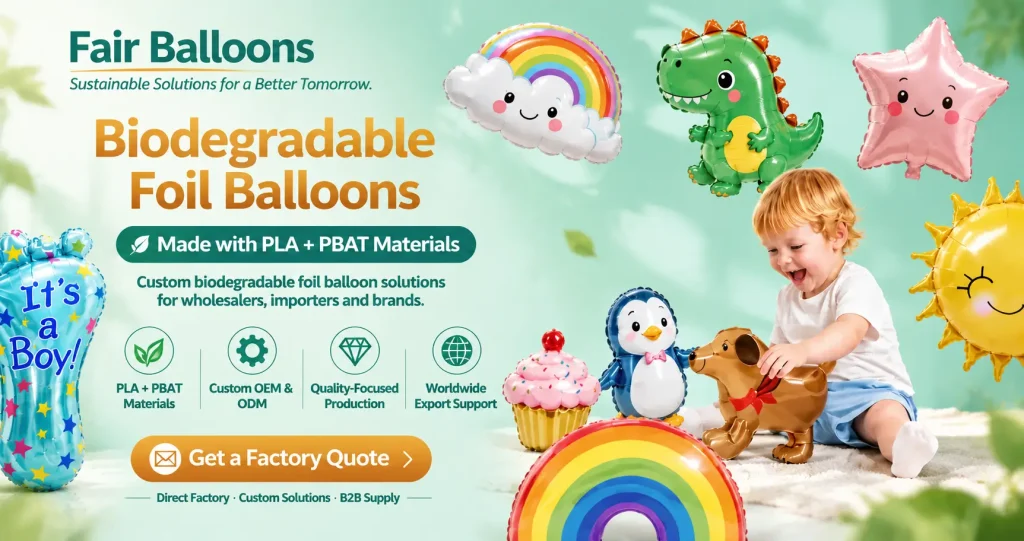

Biodegradable Mylar Balloon OEM Manufacturer: 20-Year Export Experience Factory
For global luxury event planners, international brand buyers, and multinational retail chains — an in-depth analysis of biodegradable mylar balloon factory advantages, proprietary modified PLA bio-composite film technology, and full-chain quality control. Published September 2026. Author: Engineering R&D Division. Factory: Kunshan FAIR Plant.
I. The Industry Technical Dead Zone: Why First-Generation "Eco Balloons" Failed the Market.
When global luxury events and multinational brand promotions push for low-carbon supply chains, buyers run into the same supply chain bottleneck. Traditional mylar foil balloons are manufactured from petroleum-based polyamides and polyesters that take up to 400 years to decompose naturally. That is the compliance problem. But the fix that hit the market first — the early biodegradable balloon — created a bigger operational problem.
The fatal weakness of first-generation "eco-friendly" foil balloons was high material brittleness, severe leakage, and very short helium float times. The typical deflation window was 3 to 5 days. That is a display that dies before the exhibition closes. Event planners with the strongest environmental intentions still could not accept a commercial install that deflated mid-show.
The root cause is materials science. When ordinary, unmodified polylactic acid (PLA) is used directly as the balloon base material, its elongation is insufficient (under 10 percent), brittleness is extremely high, and impact resistance is poor. Slightly higher internal pressures after inflation immediately trigger micro-cracks in the film substrate, and air-tightness decays rapidly within 24 to 48 hours. This is the core technical dead zone that kept biodegradable foil balloons out of commercial-scale deployment for years.
After two years of independent molecular-level R&D, the FAIR engineering division resolved this bottleneck by engineering a proprietary modified PLA bio-composite film matrix. The matrix maintains 100 percent industrial composting degradation while retaining the high gas barrier, heat-seal strength, and metallic print effects of traditional PET and nylon composites. This is what makes the biodegradable option commercially viable, not just environmentally acceptable.
II. Four Core Breakthroughs of the Modified PLA Bio-Composite Film.
The modified PLA bio-composite film is the engineering core of the product. Four performance metrics were addressed in the R&D process, and each one had to be solved simultaneously — solving one in isolation is what produced the first-generation failures.
For luxury brands with higher sensory and eco requirements, our specialized eco foil balloons also support customized contract manufacturing using ScentedSilk Biofilm material — an extended option for brand programs where the tactile and olfactory profile is part of the deliverable.
III. Four International Certifications: The Compliance Chain for Export Trade.
"Biodegradable" must not be a marketing concept. It must be backed by traceable third-party laboratory reports. Sourcing from FAIR provides B2B distributors with the full compliance chain needed to clear international green trade barriers — four documents that cover everything from decomposition performance to chemical safety to physical toy regulations.
These four certifications cover the entire compliance chain — from biodegradation performance to chemical safety to physical toy regulations. When sourcing from FAIR, we provide a complete, verified certification package for your channel reviews. For Amazon e-commerce merchants or retail suppliers seeking low MOQ customization, this package is what makes listing approvals smooth instead of a back-and-forth with your compliance department.
IV. Full Flexible OEM/ODM Contract Manufacturing Capability.
FAIR has been an established high-tech factory since 2007. We supply the bio-composite film and support comprehensive OEM/ODM flexible contract manufacturing for global eco-conscious brands. The specification range below is the working matrix we quote against.
| Customization Parameter | Sourcing Range & Specification | Technical Significance for Importers |
|---|---|---|
| Balloon Dimensions | 9-inch to 40-inch standard sizes | Supports everything from mini hand-held stick balloons to giant parade balloons from a single production base. |
| Shape Customization | Unlimited structural shapes | CAD/FEA stress simulation, 3D character mapping, custom brand IP and text shapes. |
| Printing Methods | Multi-color rotogravure / Screen printing | Precision rotogravure overprinting with standard Pantone ΔE ≤ 1.0 color accuracy. |
| Contract MOQ | From 1,000 units per SKU | Existing molds with customized logo start at 1,000 units. New molds start at 3,000 units. |
| Packaging Options | Supermarket-grade retail packaging | Supermarket header bags, barcode labels, direct Amazon FBA packaging and labeling. |
V. Full-Chain B2B Quality Control System.
Every batch of balloons undergoes a strict 24 to 48-hour 100 percent inflation pressure test in an independent inspection workshop before packaging. Zero defects upon arrival is the target, and the QC system is what enforces it.
IQC — Incoming Quality Control. Stringent batch-sampling inspection of raw bio-based resin pellets, barrier films, valves, and water-based inks. Non-compliant raw materials are immediately rejected before they enter the production line.
IPQC — In-Process Quality Control. Fully automated forming lines equipped with real-time online ultrasonic thickness monitoring (accuracy plus or minus 0.1 micrometers) and heat-seal temperature monitoring. Drift is caught at the line, not at the final inspection bench.
OQC — Outgoing Quality Control. 100 percent pressurized inflation leak testing plus 24-hour static floating evaluation. If any batch leaks exceed 0.5 percent, the entire batch is recalled and re-inspected. The recall threshold is the number that separates a QC system from a QC claim.
Quarterly SGS Audits. We proactively send mass production samples to SGS laboratories each quarter to ensure our products continuously meet international environmental standards. The quarterly cadence catches formulation drift before it reaches a buyer's compliance department.
VI. Export Supply Chain Logistics Support.
Unlike traditional petroleum-based polymers, PLA-PBAT bio-films are hydrolytically sensitive. Exposure to high temperature and high humidity during sea transport — container interiors can reach 50 to 60 degrees Celsius on equatorial trade routes — can initiate premature degradation. This is the logistics risk that most suppliers do not disclose until it is too late.
FAIR has engineered a customized logistics packaging solution: independent moisture-proof barrier bags, desiccant packets, and heavy-duty corrugated outer master cartons. The triple-barrier packout protects the film from moisture ingress and thermal cycling across the ocean transit window. We provide complete export documentation including FORM A certificates of origin, packing lists, and Bill of Lading to simplify your importing process.
VII. Frequently Asked Questions
Under industrial composting conditions (58°C, 65% humidity), the biodegradation rate of FAIR's PLA+PBAT film reaches 89 percent or higher within 180 days, complying with EN 13432 standards. When discarded in natural environments such as soil or ocean, the degradation cycle is slower, but the material eventually decomposes completely into carbon dioxide, water, and organic biomass with zero microplastic residue. The key distinction is that industrial composting degrades on a defined timeline, while natural environment degradation occurs over a longer period without leaving persistent microplastic residue.
Yes. Through the nano-crystalline maze structure achieved by our modified PLA+PBAT blend material, helium molecular permeability is reduced by over 95 percent. Real-world test data confirms a 15-plus day static floating cycle, matching traditional PET and nylon composites. This solves the rapid leakage issue that plagued first-generation degradable materials, where unmodified PLA film fractured under inflation pressure and lost helium inside 24 to 48 hours.
The MOQ for existing mold color changes or logo printing is 1,000 units per SKU. For brand new 3D shaped balloons requiring custom mold tooling, the MOQ is 3,000 units. We provide a high-fidelity handmade prototype sampling stage, during which we can provide physical samples and official SGS certification reports before formal mass production. The sample approval is the gate — production does not start until the buyer signs off on the physical sample and the certification package.
Our biodegradable Mylar balloons cover mainstream markets including the EU, North America, Australia, Japan, and South Korea. EU buyers can use our SGS biodegradation and EN 14855-1 composting reports to access organic waste processing streams. North American buyers can use our SGS RoHS 2.0 and EN71 certificates to satisfy US state-level environmental regulations. For other markets, we supply the relevant test documentation for the specific jurisdiction — tell us the destination market before we quote, and we confirm which documentation set applies.
Because biodegradable polymers are sensitive to hydrolytic degradation, we package shipments using a triple-barrier system: independent moisture-proof vacuum-sealed bags, desiccant packets, and triple-wall master cartons. Under normal dry, dark, and room-temperature storage conditions, uninflated biodegradable balloons can be preserved for 2 to 3 years without quality deterioration. Storage in a hot or humid warehouse shortens the effective shelf life, so we recommend climate-controlled storage for any inventory held longer than 12 months.
Standard customized printing orders (1,000 to 5,000 units) require approximately 25 to 30 working days from sample approval to mass production shipment. Fully customized shapes requiring new mold tooling take 35 to 45 working days. We recommend coordinating order schedules 2 to 3 months before holiday peak seasons, because production capacity books out and there is no rush fee that unlocks a line that has already been scheduled.
Talk to the Line, Not a Trading Desk
From material R&D to mass production quality control, from environmental certification document packages to specialized export logistics packaging, FAIR's 20-year export experience team provides complete one-stop service for B-end partners globally. Contact us at xia@foilballoon.cn. Fast technical reply within 12 business hours.
Kunshan Fair Craft Products Co., Ltd. (FAIR) · Direct Source Factory Established 2007 · Registered Capital RMB 5,000,000
PLA-PBAT High-Barrier Bioplastic Co-extrusion · 15+ Days Helium Float · OEM/ODM Global Contracts
PEBA Member since 2019 · SGS EN 13432 Industrially Composting Certified · SGS RoHS 2.0 Heavy Metal Free · SGS EN71-3 Toy Safety Compliant · ISO-Aligned QC System · AOI Defect Monitored