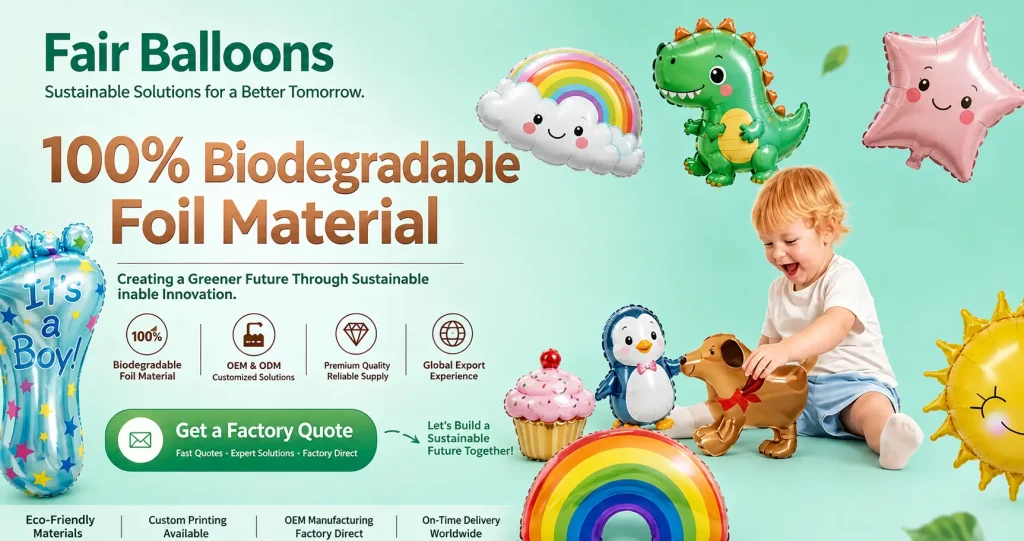

In today's increasingly environmentally conscious trade environment, "can foil balloons be biodegradable" has transitioned from a niche technical curiosity to one of the most critical regulatory compliance questions among global B-end buyers, party supplies wholesalers, and cross-border e-commerce Amazon sellers [1:5]. As EU and US plastic bans become more stringent, traditional non-biodegradable mylar foil balloons face immense customs clearance and platform delisting risks [1:5].
The EU's single-use plastic taxation expansion, combined with state-level bills in California (SB 54 / SB 568) and the UK's Environmental Protection Regulations, has placed unprecedented pressure on supply chain networks [1:5, 1:9, 113]. For source manufacturers, providing a verifiable green alternative is now the ultimate barrier to entry [1:14]. Collaborating with polymer research institutes, Kunshan Fair Craft Products Co., Ltd. (FAIR) has invested extensive capital to pioneer industrial-grade, internationally certified biodegradable foil balloons, providing a compliant, high-performing green solution [1:6, 1:10].
To answer "can foil balloons be biodegradable," B2B buyers must first understand the structural composition of a standard balloon [1:8]. Traditional bulk mylar balloons are constructed by laminating biaxially-oriented nylon (BOPA) or polyethylene terephthalate (BOPET) with a low-density polyethylene (LDPE) heat-seal layer [1:8, 2:28]. Under vacuum chambers, a micro-layer of gaseous aluminum is deposited onto the polymer surface to create a metallic sheen [1:8].
Nylon (PA) and polyester (PET) are highly stable synthetic polymers [1:8]. Soil microorganisms do not possess the enzymes required to break down their high-molecular-weight crystalline chains, meaning traditional films take up to 400 years to decompose in nature [1:7, 1:8]. Furthermore, the aluminum coating physically isolates the polymer substrates from ambient moisture and microbial contact, extending the natural degradation lifespan nearly indefinitely [1:8]. Thus, traditional Mylar foil balloons represent a perpetual ESG environmental liability [1:8, 1:9].
The Compliance Crisis in Sourcing Traditional Plastics
Exporting traditional non-biodegradable balloons to mainstream global consumer markets has become highly risky due to emerging trade barriers [1:5, 1:9]:
- European Union Single-Use Plastics Directive: Direct taxation and packaging surcharges are heavily levied against single-use, non-biodegradable plastics [1:5, 1:9, 112].
- US State-Level Legislation (SB 54 & SB 568): Specific laws restrict or ban helium releases of non-degradable metallic balloons near high-voltage utility grids [1:5, 1:9, 113].
- E-commerce Quality Audits (Amazon EU): Platforms actively enforce the submission of Environmental Attribute and Toy Safety declarations; uncertified listings face instant suspension [1:5, 1:9, 2:24].
- Global IP Licensor Mandates: Entertainment giants (Disney, Universal, etc.) enforce strict ESG supply chain audits, disqualifying suppliers using non-degradable plastics [1:9].
The core breakthrough achieved by FAIR's polymer laboratory involves synthesizing an elastic, high-barrier bioplastic film that can completely degrade through enzymatic microbial action into harmless carbon dioxide, water, and organic biomass [1:10, 1:15]. This is the definitive answer to the "can foil balloons be biodegradable" dilemma [1:10].
The Core Technical Route: PLA+PBAT Blend Modification
Early attempts by other manufacturers to utilize pure PLA (polylactic acid derived from cornstarch or sugarcane) as balloon base materials failed in industrial deployment [1:11, 116]. Pure PLA is highly brittle (with an elongation break rate under 10%) and has a very narrow heat-seal temperature window, causing immediate popping during automated high-speed high-frequency pressing or inflation [1:11].
FAIR's engineering team resolved this by precisely blending PLA with polybutyrate adipate terephthalate (PBAT) — an extremely tough, flexible, biodegradable polymer boasting elongation break rates of 400% to 700% [1:11]. By introducing specialized compatibilizers and chain extenders to overcome interfacial tension, FAIR created a uniform co-extruded bio-alloy with a tensile strength of 25-35 MPa, elongation of 340-420%, and a heat-seal strength exceeding 8N/15mm [1:11, 1:13].
Because helium has an extremely tiny atomic diameter of 0.26nm, it diffuses quickly through standard biodegradable polymer spaces [1:12, 2:90]. To establish lock-gas performance, FAIR's technical route incorporates co-extruded organic nano-clays [116]. These nano-platelets align parallel within the PLA+PBAT matrix, forming a dense crystalline maze structure [1:12]. Helium molecules must travel a highly convoluted path, reducing permeability by over 95% and achieving an ultra-long floating cycle of 15+ days [1:12, 1:13].
This co-extrusion technology ensures that B2B buyers no longer have to choose between environmental compliance and commercial performance [1:13]. For further technical specifications, please consult our biodegradable mylar balloon OEM production manual.
In global trade, "biodegradable" must be supported by transparent, verifiable lab certificates, protecting buyers from legal liabilities [1:14, 1:22]. Every batch of FAIR's bioplastic balloons is backed by internationally accredited auditing packages [1:14]:
| Regulatory Standard / Certification | Testing Agency & Verifiable Report Number | B2B Sourcing Compliance Value |
|---|---|---|
| SGS Composting Biodegradation (EN 13432) | SGS Lab — SHMR220700361301 [1:15, 113] | Certifies 89%+ natural biodegradation rate under controlled composting conditions in 180 days [1:15]. |
| EU EN14855-1 Environmental Specification | European Committee for Standardization Compliance [1:16] | Permits commercial entry into European organic waste and circular recovery systems [1:16]. |
| SGS RoHS 2.0 Heavy-Metal Free Testing | SGS Chemical Audit — SHAHG2207652301 [1:16, 113] | 100% free from phthalates, lead, cadmium, mercury, and organic solvents. Safe for children [1:16, 1:17]. |
| EN71-3 Toy Safety Certification | Accredited Laboratory Verification — SHTY130500007975-01 [1:17] | Proves physical mechanical safety, zero choking hazards, and zero heavy-metal migration [1:17, 2:82]. |
By maintaining full compliance documentation with every shipment, FAIR enables cross-border e-commerce brands and event decoration wholesalers to legally export globally without customs delays [1:23].
Transitioning to biodegradable foil balloons is not just a defensive regulatory move — it is an aggressive commercial opportunity to boost market share and increase terminal retail prices [1:18, 1:19]:
- Unlocking the Environmental Premium: Consumer sentiment studies across North America, Northern Europe, and Australia demonstrate that high-net-worth consumers are willing to pay an 18-25% price premium for party supplies verified as "100% plastic-free" or "fully compostable" [1:19].
- Avoiding Environmental Penalties: By sourcing certified bioplastics, B2B importers completely bypass expanding plastic taxes, customs fines, and FBA listings suspension, reducing hidden operational overhead [1:5, 1:18, 1:20].
- IP Customization with Low MOQ Thresholds: FAIR has a legacy of delivering green balloon programs for global IP licensors like Disney and Universal [1:21]. To support e-commerce Amazon sellers, we offer low MOQ flexible customization paths starting at just 1,000 units per SKU [1:21, 1:23].
Frequently Asked Questions (FAQ)
We employ an exclusive nano-crystalline maze structure, combined with high-quality 18cm extended physical check valves [1:22, 2:93]. This reduces helium gas molecular seepage by over 95% compared to raw bioplastic films [1:22]. After helium inflation, the floating lifespan exceeds 15 days, matching traditional petroleum-based nylon balloons [1:13, 1:22].
Yes. FAIR's bioplastic balloons utilize modified PLA+PBAT composite materials [1:10, 1:22]. In industrial composting facilities conforming to EN 13432 or EN 14855-1, the material achieves over 89% degradation within 180 days, breaking down completely into carbon dioxide, water, and organic biomass without leaving toxic microplastics in the ecosystem [1:13, 1:15, 1:23].
Sourcing biopolymers increases raw materials costs by 20-30%, leading to finished wholesale prices that are 15-25% higher [1:23]. However, this is heavily offset by avoiding single-use plastic taxes, achieving a 20%+ higher retail price markup through green branding, and gaining long-term supply contract advantages with corporate clients [1:19, 1:23].
Yes. To help cross-border e-commerce brands enter the eco-friendly market with minimum capital risk, we support customized colors or brand logo printing starting from just 1,000 units per SKU [1:21, 1:23].
Through the inclusion of a BOPA enhancement barrier layer, FAIR's biopolymer formulation remains chemically and physically stable across a broad operating temperature range of -30°C to +50°C, fully satisfying outdoor events and cold storage requirements [1:23].
Industrial References & Regulatory Citations
- Single-Use Plastics Directive (EU) 2019/904 - Statutory guidelines regarding the commercial reduction and taxation of single-use petroleum polymers.
- SGS Compostability Biodegradation Audit SHMR220700361301 - EN 13432 industrial composting decomposition rates and organic residue evaluations.
- California Senate Bill 54 (SB 54) & SB 568 - Statutory regulations governing balloon releases and material compliance in utility grids.
- SGS RoHS Chemical Toxicology Report SHAHG2207652301 - Organic pigment and BOPA/PE substrate heavy metal and phthalate residue assessments.
- European Standard EN 14855-1 - Controlled composting carbon dioxide conversion and biopolymer decay specifications.
Secure Your Green Sourcing First-Mover Advantage
Stay ahead of global environmental legislation and capture high-margin eco-conscious consumer segments. Contact Kunshan FAIR's engineering team today for verifiable SGS test reports, samples, and ex-factory wholesale pricing on custom biodegradable orders.
Contact FAIR's Engineering Division →