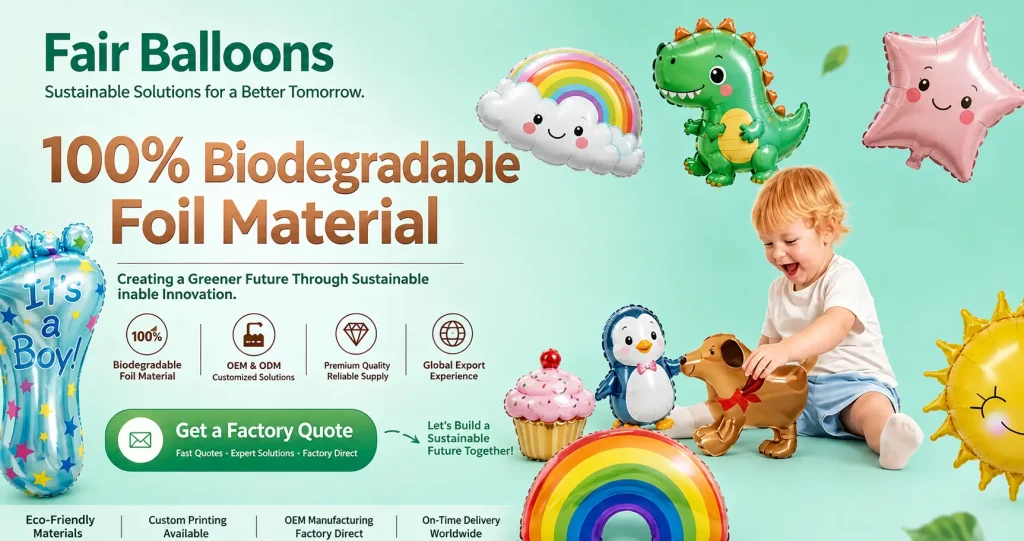

Biodegradable Foil Balloons vs. Latex: The B2B Sourcing & Polymer Comparison
As an industry-leading, standard-setting direct-source foil balloon factory established in 2007 with a registered capital of 5 million RMB, FAIR provides an exhaustive material science analysis comparing next-generation PLA+PBAT biodegradable foil balloons with traditional natural latex and petroleum-based Mylar substrates for global sourcing directors.
I. Strategic Sourcing Profiles: Navigating Mylar vs. Latex Balloons
In the global wholesale party supply and promotional merchandising sectors, purchasing decisions have historically been split down a single line: mylar vs latex balloons [7]. Traditional natural rubber latex products offered low unit costs and biodegradable properties but suffered from poor helium retention, limited display times, and high allergen risks. Conversely, conventional metallized Mylar balloons (BOPET polyester laminated with polyethylene) provided outstanding gloss, complex shaped configurations, and multi-week helium floating life, but presented a severe microplastic and litter hazard due to their completely non-biodegradable petroleum-based polymer chains [8].
However, mounting regulatory pressures—including European Union Single-Use Plastics Directive (EU) 2019/904, California SB 54, and SB 568—have forced global distribution chains to urgently seek compliant alternatives [5, 8]. This shift has propelled the commercial demand for specialized biodegradable foil balloons, which bridge the gap by offering the high-end B2B performance of Mylar alongside the environmental safety profiles required under strict green compliance laws [4].
For procurement directors overseeing high-volume distribution channels, simply stocking a generic mix of mylar balloons latex or mixed latex and foil balloons is no longer a viable long-term strategy [4]. Understanding the fundamental polymer mechanics and technical specifications of next-generation bio-films is critical to securing regional supply integrity and avoiding heavy Extended Producer Responsibility (EPR) taxes on non-recyclable materials [8].
II. Polymer Barrier Physics: PLA+PBAT vs. Natural Latex & Synthetic BOPET
To understand why next-generation biopolymers represent a major technical breakthrough, we must analyze the physical structure of traditional latex and mylar balloons compared to certified compostable multi-layer films [4, 8]. Natural rubber latex is a highly porous elastomer; helium gas (which possesses an extremely small molecular radius) easily diffuses through the vulcanized polymer network, limiting latex floating life to less than 12-24 hours unless treated with internal polymer gels.
Conventional Mylar utilizes biaxially oriented polyethylene terephthalate (BOPET) [7]. While BOPET is an exceptional gas barrier, its synthetic ester links are highly resistant to moisture, micro-organisms, and UV radiation, taking up to 400+ years to fragment into harmful microplastics.
FAIR's patented green technology group has resolved this friction point by developing a specialized co-extruded bio-laminated film composed of Polylactic Acid (PLA), Polybutylene Adipate Terephthalate (PBAT), and an organo-modified nanoclay dispersion [2]. PLA (derived from fermented plant starch) provides rigid mechanical strength, high tensile modulus, and a high-barrier crystalline structure [8]. However, raw PLA is extremely brittle, making it unsuitable for standard inflation expansion [8]. By compounding PLA with highly flexible, biodegradable PBAT and a microscopic layer of exfoliated nanoclay plates, we construct a flexible yet gas-tight composite film [8]. The high-aspect-ratio nanoclay plates create a highly tortuous diffusion pathway, forcing helium molecules to navigate a complex maze, thereby locking the gas inside and matching the floating performance of traditional metallized foils [8].
| Sourcing Metric | Traditional Latex Balloons | FAIR PLA+PBAT Biodegradable Foil | Standard Petroleum Mylar (BOPET) |
|---|---|---|---|
| Raw Material Base | Hevea Brasiliensis Sap (Latex Elastomer) | Corn Starch PLA + Synthesized PBAT + Nanoclay | Petroleum-Derived PET + Polyethylene |
| Helium Floating Life | 12 to 24 Hours (Without Hi-Float gel) | Guaranteed 5 to 7 Days (Air/Helium) | 14 to 30 Days (Excellent barrier) |
| Degradation Profile | Slow microbial disintegration (weeks to years) | 100% Industrial Compost (180 days EN 13432) | Non-biodegradable (400+ years to fragment) |
| Custom Shapes Prototyping | Extremely limited (standard round/heart shapes only) | Unlimited (3D curves, custom shapes, character CAD) | Unlimited (Standard commercial molds) |
| Safety & Chemical Audits | High allergen risk (natural latex proteins) | Allergen-free, Heavy-metal-free, Phthalate-free | Phthalate/heavy metal trace risks in cheap inks |
III. Floating Performance & Custom Shape Engineering
One of the primary B2B constraints when choosing between latex and foil balloons has always been shape flexibility [7]. Commercial visual merchandisers, shopping malls, and high-budget events require complex dimensional installations. For example, creating heart shaped latex balloons [18] or specialized dinosaur latex balloons [18] is physically limited by the isotropic expansion of latex, which pulls the film into a round blob as inflation increases.
Laminated bio-foils completely break this constraint [8]. Because the PLA+PBAT multi-layer composite film is welded under high-frequency thermal molds rather than expanded from a liquid state, we can achieve millimeter-perfect replication of complex CAD structures. Sourcing managers can request highly complex, multi-panel designs, custom-designed character branding, and flawless 3D organic curves with zero distortion [3, 10].
Furthermore, while natural rubber latex is prone to rapid oxidized weathering (losing its gloss and turning chalky and opaque in outdoor settings), FAIR's compostable foil balloons feature a brilliant high-purity vacuum-metallized outer shell [8]. This layer provides a stunning, high-reflectivity mirror surface that remains visually perfect throughout the entire 5-to-7 day display window [14]. This makes them ideal for both high-end indoor experiential visual merchandising and challenging outdoor promotional installations [25].
🌱 Navigating Global SCM Compliance Audits: SGS & RoHS Certifications
For major commercial brands and multinational toy distributors, green claims must be backed by verifiable scientific data. To protect our global partners from the legal penalties associated with single-use plastic bans, FAIR has subjected our PLA+PBAT-nanoclay film formulations to exhaustive, independent laboratory audits [5].
🥇 1. EN 13432 Composting Biodegradation: Our material is officially documented under SGS Test Report No. SHMR220700361301 [5]. This verifies 100% biodegradation and industrial soil mineralization within 180 days, breaking down completely into carbon dioxide and water with zero plastic micro-fragments or ecotoxic residues left behind [5, 8].
🥈 2. RoHS Heavy-Metal-Free Compliance: Officially verified under SGS Report No. SHAHG2207652301, guaranteeing that all raw resins, laminated barrier layers, and high-fidelity printing inks are 100% lead-free, cadmium-free, and phthalate-free, fully complying with US ASTM F963 and EU REACH chemical standards [5].
🥉 3. Active PEBA Alliance Membership: As an active member of the PEBA (Pro-Environment Balloon Alliance) since 2019, FAIR strictly follows best-practice guidelines regarding child safety, responsible display, and the proactive phase-out of non-biodegradable promotional balloon releases [5].
IV. Logistics Strategy: Managing Material Hydrolytic Sensitivity in Sea Freight
A critical operational factor that traditional wholesale distributors must prepare for when transitioning from conventional Mylar to next-generation bio-films is hydrolytic sensitivity [8]. Unlike inert petroleum-derived plastics (BOPET/PE) which can sit indefinitely in high-humidity warehouses with zero physical degradation, PLA+PBAT biopolymers are engineered to degrade in the presence of moisture and microbes [8].
During ocean freight—particularly transit routes crossing equatorial waters—high ambient humidity inside shipping containers can trigger "premature hydrolysis" in bio-materials, leading to micro-weakening of the polymer bonds and potential pinhole leakage upon arrival [8].
To safeguard our global partners' inventory and guarantee maximum sourcing ROI, FAIR utilizes customized industrial export packaging standards. Every bulk run of our compostable foil balloons is nested in vacuum-sealed anti-static polybags equipped with active moisture-absorption desiccant packs [8]. These are packed in ultra-thick, five-layer double-corrugated export cartons (ECT-44 rating) lined with water-resistant vapor barriers. Furthermore, our R&D team executes a rigorous 48-hour automated static inflation leakage test under controlled pressure chambers on every batch before container sealing [7], delivering a 100% verified, zero-defect cargo directly to your logistics hubs.
Secure Your Green Sourcing Strategy with FAIR
Looking to eliminate plastic tariff liabilities under California SB 54, EU Single-Use Plastic mandates, or state-level Single-Use Plastic bans? Partner with China's premium, direct-source biodegradable foil balloons manufacturer. Request a custom corporate catalog, technical material science reports, or bulk container contract sheets today.