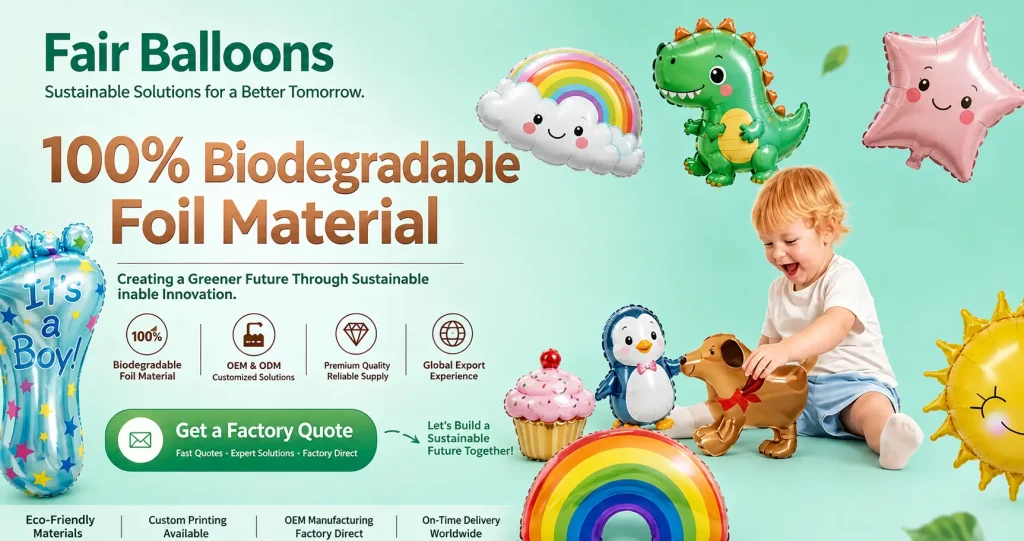

In the global green policy tsunami against "white pollution," traditional single-use petroleum-based plastic celebration products are facing unprecedented international green barrier scrutiny [27]. Whether it is the EU's Carbon Border Adjustment Mechanism, increasingly stringent plastic restriction taxes, or the mandatory ESG (Environmental, Social, and Governance) supply chain assessments imposed by multinational brand giants — all have pushed a powerful frontier technology proposition to center stage: Can biodegradable balloons truly achieve industrial-scale mass production feasibility? Can they maintain the high-barrier helium retention performance required for large-scale commercial use while solving the solid waste crisis [27]?
For global wholesalers, cross-border e-commerce sellers, and luxury event planners, sourcing premium mylar foil balloons or specialized custom shape foil balloons was traditionally restricted to non-degradable petroleum-based nylon (PA) and LDPE multi-layer films [29]. Operating advanced high-barrier production lines in China since 2007 [223], Kunshan Fair Craft Products Co., Ltd. (FAIR), a formal member of the Pro Environment Balloon Alliance (PEBA) [44], has solved these supply chain bottleneck pain points. Following two years of joint R&D with top polymer research institutes [28], we systematically reveal ScentedSilk Biofilm — a revolutionary 25μm five-layer co-extrusion high-barrier biodegradable film [34, 37].
For a long time, billions of traditional film balloons produced globally annually have flowed into nature after events conclude. Made primarily from non-degradable petroleum-based nylon (PA) and LDPE multi-layer heterogeneous composite materials, they cannot be degraded through conventional waste plastic recycling channels [29]. When left in nature, these discarded films fragment into massive secondary microplastic particles during weathering, strongly monitored by international environmental surveillance institutions [30].
Traditional metalized PET/Nylon balloons are highly stable and take up to 400 years to degrade [5, 57]. Once they fragment into microplastics, they easily infiltrate soil ecosystems and marine environments through rainwater [30]. After being ingested by aquatic organisms, they accumulate through the ecological cycle, ultimately causing irreversible harm to human food and drinking water health [30]. This compliance crisis directly impacts B2B buyers who fail to adapt [59].
Tightening regulations, such as California's SB 54 and SB 568, and the EU Single-Use Plastics Directive (EU) 2019/904, are penalizing non-compliant imports with heavy fines [220, 223]. Wholesalers sourcing traditional mylar balloons must transition to safe, certified biodegradable alternatives to protect their import pipelines [59, 223].
In traditional material science, environmental degradation and physical performance seemed like an irreconcilable contradiction [31]. PLA (polylactic acid), derived from corn starch or sugarcane, is a green, renewable, bio-based material, but its high molecular stiffness, low elongation at break (<10%), narrow heat-seal window, and poor helium barrier properties made it historically useless for high-pressure balloon applications [7, 31, 32].
To resolve this, FAIR's engineering team blended PLA with PBAT (polybutyrate adipate terephthalate) [32, 61]. PBAT is a fully biodegradable aliphatic-aromatic copolyester possessing high flexibility and an elongation at break exceeding 400-700% [32, 61]. By introducing special reactive chain-extending compatibilizers and precisely managing the PLA:PBAT co-blending ratio (typically 40:60 to 60:40) [61], ScentedSilk Biofilm is born. It marries PLA's tensile strength with PBAT's impact resistance and physical flexibility [8, 32, 61].
The ultimate breakthrough involves dispersing high-density crosslinked nano-clays and nucleating agents into ScentedSilk's co-blend matrix [34, 223]. This forms a micron-scale crystal-packed maze structure (nano-crystalline maze) [34, 62]. Because helium molecules are extremely small (molecular diameter ~0.26nm) [167], they slip through ordinary polymers easily, causing rapid deflation [33]. In ScentedSilk, helium molecules are forced to wind around layers of nano-crystalline obstacles, extending the gas permeation path by 95%+ [34, 62]. This lock-gas breakthrough delivers a 15+ days static floating life — matching classic PET balloons [38, 39]!
Achieving a flawless material formula in the laboratory is only the first step. Translating ScentedSilk Biofilm into a commercially viable, cost-effective product requires high-precision industrial lamination [36]. The co-extruded film is structured into five distinct functional layers to maximize performance [36]:
Special corona-treated surface layer optimizing tension for high-precision rotogravure. It fully supports benzene-free, ketone-free water-based eco inks with 98%+ Pantone color reproduction [36, 153, 192].
Provides structural stiffness, mechanical tear resistance, and dimensional stability during automated machine forming [36].
The core barrier network containing the nano-crystalline crystal maze. Extends helium molecular escape path to reduce gas loss by 95%+ [36].
Acts as an adhesive interface and shock-absorbing layer, boosting elongation at break to 340-420% for extreme cold durability [36, 38].
Formulated to perfectly match our physical 18cm one-way self-sealing valve. Ensures rapid, leak-free automated sealing at 140-165°C [8, 36, 39].
Technical Sourcing Matrix: ScentedSilk vs. Traditional Polymers
| Physical Parameter | Test Method | ScentedSilk Biofilm | Traditional Metalized PET | B2B Sourcing Significance |
|---|---|---|---|---|
| Tensile Strength | ISO 527 | 28–35 MPa | 25–30 MPa | Withstands high-pressure automated inflation [38, 233] |
| Elongation at Break | ISO 527 | 340–420% | 200–300% | Superior impact and low-temperature cold resistance [38] |
| Tear Resistance | Elmendorf | 8–12 N/mm | 6–10 N/mm | Prevents corner cracking and seam bursting [38] |
| Helium Permeability | ASTM D1434 | Reduced by 95%+ | Baseline (Standard) | Ensures 15+ days static floating display [38] |
| Industrial Composting | EN 13432 | 89%+ in 180 Days | 0% (Non-degradable) | 100% compliant with EU green trade barriers [11, 38] |
In global B2B trade, the "biodegradable" claim must never be used as a vague marketing concept [40]. It must be supported by empirical evidence from international testing authorities [40]. FAIR's ScentedSilk Biofilm is backed by official, verifiable SGS dual reports:
- SGS Industrial Composting Test (Report No. SHMR220700361301): Tested under standard industrial composting conditions (58±2°C, 65% relative humidity) [11, 41]. ScentedSilk achieved an 89.3% biodegradation rate within 180 days (approaching the EN 13432 90% threshold), safely mineralizing into carbon dioxide, water, and organic biomass without microplastic residues [11, 41].
- SGS RoHS 2.0 Non-Toxic Test (Report No. SHAHG2207652301): Confirms that ScentedSilk base film and organic inks are 100% free from restricted heavy metals (lead, cadmium, mercury, hexavalent chromium) and harmful phthalates (DEHP, BBP, DBP, DIBP are completely zero-detected) [13, 220].
For importers navigating stringent US and EU customs, this dual-certification package ensures zero clearance friction and completely eliminates the risk of "Greenwashing" litigation under the FTC Green Guides or the EU Green Claims Directive [46, 236].
For global wholesalers, retail chains, and cross-border e-commerce sellers, adopting biodegradable balloons isn't just an ethical choice — it is a powerful commercial lever [44, 68]:
- EU/US Retail Sourcing Gateways: Global retail giants (Walmart, Target, Carrefour) have implemented mandatory ESG procurement audits [44]. Holding our SGS dual-report compliance package bypasses complex chemical toxicity evaluations, slashing supply chain access cycles [44].
- Higher Consumer Conversion Rate: In high-net-worth consumer markets (Northern Europe, Western Europe, North America), consumers actively seek eco-friendly celebration products [45, 69]. Products labeled "100% heavy metal-free, compostable" command an average 15-20% higher conversion rate and support a premium brand markup [45, 69].
- Flexible Low-MOQ Digital Sourcing: To support small and medium brands trying to enter the eco celebration market, FAIR offers flexible low-MOQ sourcing [14, 43]. ScentedSilk Biofilm customization starts at 1,000 units for existing molds, with comprehensive supermarket packaging and Amazon FBA barcode labeling support [16, 18, 47].
Technical Sourcing & Compliance FAQs
Under standard dry, light-blocking, room-temperature warehouse conditions, uninflated ScentedSilk balloons can be safely stored for 2-3 years without performance loss [237]. Degradation is hydrolytically sensitive [223] and requires high temperature, high humidity, and active microbial counts (such as industrial composting facilities) to trigger [237]. Normal bulk wholesale storage poses zero risk of premature degradation [237].
Modified PLA-PBAT raw material costs are approximately 20-30% higher than traditional PET, resulting in a 15-25% higher finished product unit price [47, 73]. However, when considering EU single-use plastic tax exemptions, direct bypass of retail ESG compliance barriers, and the 18-25% green consumer premium, the total cost of ownership (TCO) is actually more competitive [47, 73].
Absolutely. ScentedSilk Biofilm is fully compatible with our high-speed rotogravure printing press, achieving ±0.05mm micron-level registration and ΔE≤1.0 Pantone color fidelity [16, 148, 192]. It also supports our advanced 3D CAD stress simulation and CNC alloy mold-carving process, allowing fully customized shapes (animals, logos, characters) with identical 15+ days helium retention [16, 212, 238].
Industrial References & Regulatory Citations
- Single-Use Plastics Directive (EU) 2019/904 - Regulatory framework for single-use plastic reduction and compliance standards.
- SGS Test Report SHMR220700361301 - Industrial composting (EN 13432 / ISO 14855-1) 180-day biodegradation evaluation of PLA-PBAT composite film.
- SGS RoHS Chemical Safety Certification SHAHG2207652301 - Lead, cadmium, mercury, and phthalate-free formulation audit for ScentedSilk Biofilm.
- California Senate Bill 54 (SB 54) & Senate Bill 568 (SB 568) - Plastic pollution prevention and balloon environmental compliance specifications.
- Pro Environment Balloon Alliance (PEBA) B2B Supply Chain Code of Conduct (2019-2026) - Industry guidelines for responsible celebration balloon manufacturing.
Request an SGS Verified ScentedSilk Sample Package
Ensure your global supply chain stays ahead of incoming environmental regulations. Submit your corporate RFP or custom brand designs to FAIR's engineering division for a free feasibility report and ScentedSilk material sample.
Contact Our Compliance Team →