
In the global festival supplies wholesale and cross-border e-commerce foreign trade ecosystem, balloon air leakage remains the single most critical quality concern [4]. A premium balloon that sags or deflates prematurely during an exhibition, promotional campaign, or private event directly damages brand reputation and triggers negative customer reviews [4].
An Amazon seller received massive customer complaints right before the peak holiday season: "The balloons deflated on the second day after helium inflation." When contacting his supplier, the factory dismissed his concerns, stating that "a 3% leakage rate is within standard industry allowances." The seller's store rating plummeted from 4.7 to 3.9, cutting seasonal traffic in half. What he didn't know: a high-caliber direct manufacturer targets a leakage rate below 0.1% [4]. Microscopic leakage is not "normal wear and tear" — it is a direct failure of the factory's quality control system [4].
From the perspective of polymer physics and industrial manufacturing science, resolving slow gas seepage requires a thorough understanding of raw materials and sealing mechanisms [5, 6]. Intermediary trading brokers lack direct control over extrusion parameters and tooling calibrations [25, 28]. By partnering directly with a primary contract manufacturer like Kunshan Fair Craft Products Co., Ltd. (FAIR, operating since 2007) [26], B2B buyers can enforce rigorous quality thresholds and protect store ratings [4].
Systematic testing in our materials laboratory has isolated five primary variables that compromise the hermetic integrity of mylar foil balloons [5, 6, 7]:
Self-Sealing Valve Mechanical Damage
The integrated 18cm foil balloon valve implanted inside the balloon neck is fabricated by heat-bonding two layers of micro-thin, high-density polyethylene (PE) film [5]. If a balloon inflator with an oversized diameter or rough metal burrs is inserted, the PE sealing flaps will instantly tear [5]. Additionally, during non-standard manual deflation for recycling, inserting rigid straws or sticks scratches the delicate valve seat, destroying its physical self-sealing closing function [5]. This mechanical damage represents the most common leakage cause, accounting for over 60% of all bulk complaints [5].
Physical Micro-Pinholes in the Film Substrate
During the high-speed calendering or vacuum metallization of standard petroleum-based plastic films (BOPET), minor temperature fluctuations or tension imbalances can create invisible, molecular-level tiny pinholes (micro-voids) [6]. While these pinholes are virtually undetectable during initial packaging, the extremely tiny atomic radius of helium (0.14nm) allows the gas to slowly migrate outward through these microscopic substrate channels during long-term storage under pressure [6].
Solvent Residue Embrittlement in Large-Area Ink Coatings
When customizing full-color cartoon balloons or brand-specific promotional items with heavy, dark ink, printing speed must match drying capacity [7]. If the rotogravure line's drying and curing cycle is too short, volatile organic solvents remain trapped inside the ink layers [7]. Over months of warehousing, these residual solvents slowly migrate inward, causing chronic chemical embrittlement of the underlying low-density polyethylene (LDPE) sealant layer [7]. This micro-cracking in high-stress printed areas is a major cause of slow, chronic deflation. To explore optimal printing processes, consult our B2B guide on industrial foil balloon printing methods.
Insufficient Inflation Pressure Preventing Check Valve Closure
The automatic sealing function of a Mylar balloon check valve is powered entirely by the internal-to-external pressure differential [8]. If the inflation speed is too slow or the final air pressure is too low, the built-in PE flaps do not receive sufficient force to push them tightly against the inner valve wall [8]. Without this pressure-driven physical bonding, a micro-gap remains at the valve seat, allowing gas to bleed out [8]. Correct inflation requires stable, rapid airflow past the valve flaps until the balloon's structural limit is reached, forcing the valve to close automatically upon nozzle extraction [8].
Thermal Expansion and Contraction from Extreme Climates
Helium and air volume change dramatically with ambient temperature, strictly adhering to the ideal gas law [9]. When an inflated balloon is transferred from a cold outdoor winter shipping dock into an indoor heated banquet hall under direct spotlights, the kinetic energy of the gas molecules surges [9]. If the internal volume expands past the rated pressure limits (typically ≤0.02MPa), the shear stress will forcibly rupture the heat-welded seams or the self-sealing strip's edge [9]. To prevent this structural failure, balloons taken from cold storage must be acclimated to normal room temperatures before inflation. For climate-resilient solutions, review our technical study on helium retention under extreme climates.
As a dedicated foil balloon supplier with a zero-defect mandate, Kunshan Fair Craft (FAIR) has engineered three critical defense lines into our fully automated production lines to keep leakage rates below 0.1% [4, 10]:
First Defense: Source-Level Selection of High-Barrier Materials
We reject cheap petroleum-recycled resins. All core films and self-sealing valve elements are sourced from certified global raw material suppliers [10]. Each incoming batch is tracked via its unique roll code and accompanied by SGS tensile strength and high-barrier gas transmission test reports [34, 35]. Our biaxially-oriented Nylon (BOPA)/PE composite substrate forms a dense hydrogen-bonded grid, trapping 0.14nm helium atoms and eliminating micro-pinhole seepage [5, 6]. For complete material specifications, explore our study on Nylon vs. Polyester Helium Barriers.
Second Defense: Multi-Stage Drying & Eco Gravure Printing
To execute high-resolution corporate branding on custom printed Mylar balloons, we employ automated rotogravure printing presses equipped with multi-stage infrared convective drying tunnels [11, 43]. This guarantees that eco-friendly, benzene-free, and ketone-free inks are 100% cured and dried before composite lamination [11, 44]. By eliminating volatile organic solvents, we protect the underlying LLDPE heat-seal layer from solvent-induced cracking and embrittlement [7, 11]. All pigments fully comply with EU RoHS 2.0 (SGS Tested) and CE toy safety standards [5, 11].
Third Defense: Standard 100% Inflation Leak Testing Tunnel
Unlike trading agents who rely on manual spot checks, FAIR enforces a 100% inflation leak test protocol on our assembly lines [12]. Every balloon is inflated to the design pressure and automatically monitored using photoelectric pressure sensors [51]. Any unit showing even a minor pressure drop is instantly marked and destroyed [12, 13]. This automated system ensures that bulk mylar balloons delivered to our B2B partners exhibit a perfect, ultra-long 15+ day helium retention lifespan [4, 12, 13]. Learn more about our manufacturing protocols in the mylar balloon manufacturing process handbook.
By combining automated optical inspection (AOI) with a mandatory 48-hour pressure retention test on random production samples, we ensure our global distributors receive zero-defect stock. This proactive quality control is the key to preventing retail returns, customer complaints, and Amazon store rating drops [4].
To help wholesale distributors, retailers, and event planners educate their end-user consumers and eliminate post-purchase issues, we recommend distributing these scientific operating instructions [14, 15, 16]:
1. Correct Inflation Method (Avoiding Valve Tears)
Always use a properly sized inflation nozzle [14]. Strictly prohibit using rough, burred, or oversized metal pumps which can rip the delicate PE check valve flaps [14, 15]. Maintain a steady gas flow, inflating until the balloon's body is firm but has elastic give [14]. Once inflated, quickly withdraw the nozzle; the internal gas pressure will automatically seal the check valve [14]. Avoid over-inflating under direct hot spotlights [9]. For full safe-inflation parameters, refer to our foil balloon helium safety guide.
2. Safe Deflation and Reusability Protocol
To reuse custom mylar balloons, prepare a soft, food-grade straw exceeding 18cm in length [15]. Keeping your hand steady, slowly insert the straw past the valve seat until the single-flap seal opens [15]. Allow the gas to exit naturally under gentle, flat pressure [15]. Never apply brutal external force, stomp, or fold the inflated body [15]. This ensures the valve structure remains intact for dozens of future inflation cycles [15].
3. Environmental Adaptability Rules
When bringing deflated foil balloons from cold winter storage or transport trucks into warm indoor banquet halls, do not inflate them immediately [16]. Allow the uninflated stock to acclimate to room temperature for at least 30 minutes [16]. This prevents the rapid temperature differential from triggering high-shear expansion that can destroy the self-sealing check valve or seams [9, 16].
4. Green Innovation: Zero-Residue Compostable Solutions
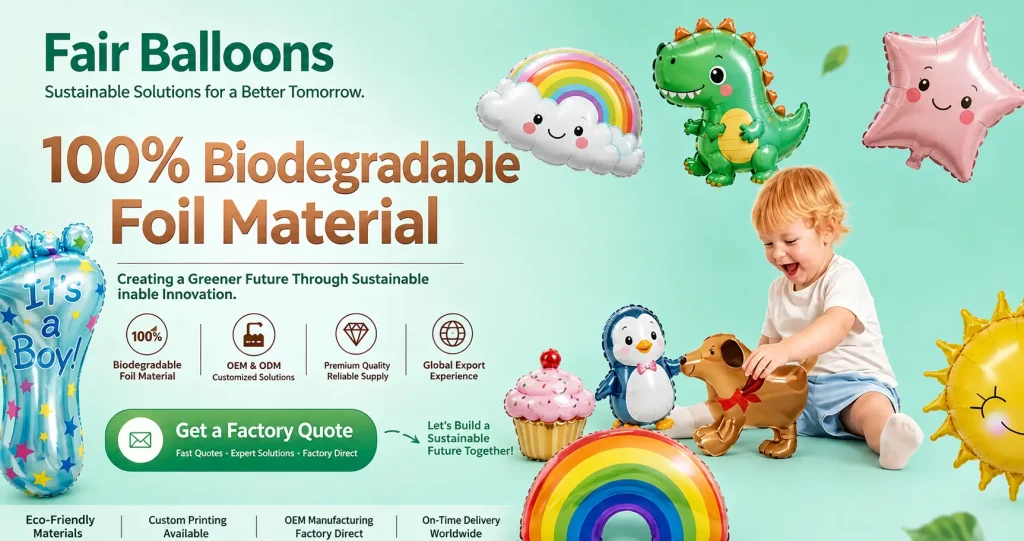
As a proud member of the Pro Environment Balloon Alliance (PEBA), FAIR has successfully resolved the high-polymer mass production barrier for eco-friendly balloons [17, 73]. Our 100% biodegradable balloons are engineered from proprietary compostable PLA-PBAT-nanoclay films [17]. In strict physical cyclic pressure testing, our biodegradable foil balloons match traditional foil balloons in tensile strength, gas barrier performance, and helium retention [17]. This allows distributors to satisfy strict regional plastic bans without sacrificing float performance [5, 17]. To explore our eco-friendly certifications, review our SGS Composting Report or see our SGS RoHS Chemical Purity Report.
Leakage & Sourcing FAQ
Yes. If micro-leakage occurs at the inflation neck, it is almost always due to an incomplete self-sealing valve closure. Event planners can resolve this by gently massaging the valve channel to flatten the inner PE flaps, allowing internal pressure to seal the gap. If a micro-puncture occurs on the body seam, a small piece of high-purity clear packing tape can temporarily seal the leak, though direct factory prevention remains the only permanent B2B solution.
Because we implement a 100% automated pressure test tunnel and a 48-hour static sample test, our average bulk defect rate is held below 0.3%. In the rare event of transit damage or a batch failing our quality threshold, we offer 100% replacement or direct credit adjustments on your next production run, backed by our comprehensive sales agreement terms.
Absolutely. Every custom mascot, licensed character, or logo balloon manufactured at FAIR features our high-purity, non-stick PE self-sealing check valve. As long as end users follow our soft-straw deflation protocol, our custom shapes can be deflated, flat-packed, and re-inflated repeatedly.
Industrial References & Regulatory Citations
- ASTM F963-16 - Standard Consumer Safety Specification for Toy Safety, Section 4.27 on Balloon Choking Hazards.
- European Standard EN 13432 - Requirements for packaging recoverable through composting and biodegradation.
- Kunshan Fair Craft Products Co., Ltd. (FAIR) OEM Whitepaper (2026) - Valve heat-sealing parameters, rotogravure curing gradients, and pneumatic testing protocols.
- SGS RoHS Chemical Safety Report SHAHG2207652301 - Quantitative testing for restricted heavy metals and phthalates.
- California Senate Bill SB 54 - Plastic Pollution Prevention and Packaging Producer Responsibility Act compliance standards.
Secure Your Supply Chain with Zero-Leak Balloons
Bypass intermediaries and trade agents. Partner with Kunshan Fair Craft to protect your brand reputation, lower your unit sourcing costs, and request custom CAD prototypes.
Get Direct Factory Quote →