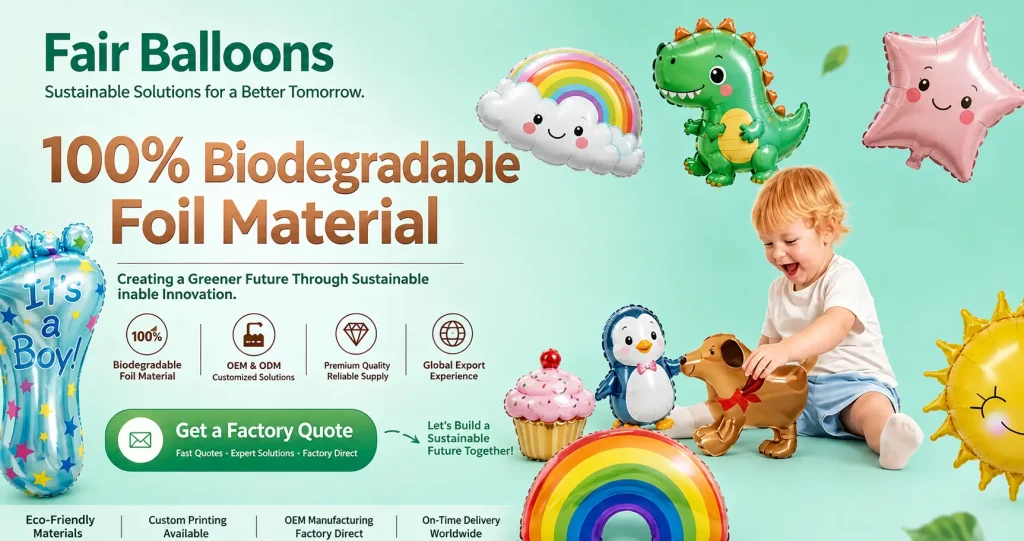

Biodegradable Foil Balloons: Custom Compostable Mylar Balloons Factory
A biodegradable balloon is not a standard balloon made from a different material. It is a different product with a different production model, a different storage life, and a different disposal path. The buyer who treats it as a like-for-like swap for a PA/PE balloon is the buyer who discovers — after the container lands — that the material started aging the day it was made and the shelf life is measured in years, not decades.
I. What PLA+PBAT Actually Is, and Why the Blend Matters.
Biodegradable foil balloons are built on a PLA+PBAT polymer blend — two bio-based polymers combined because neither one alone can deliver a functional balloon film. PLA (polylactic acid) comes from renewable plant feedstock such as corn starch or sugarcane. It is rigid, has good tensile strength, and degrades under industrial composting conditions. PBAT (polybutylene adipate terephthalate) is a compostable polymer with high flexibility and elongation. Alone, PLA is too brittle for a balloon that has to stretch into a sphere. Alone, PBAT is too soft to hold a stable film barrier. The blend is what makes the material work as a balloon.
This is the first thing buyers get wrong. A supplier claiming "PLA balloon" without the PBAT component is either misrepresenting the material or shipping a film that will fracture under inflation. A supplier claiming "biodegradable" without naming the specific polymer blend is not telling you what the balloon will actually do in the disposal environment.
The second thing buyers get wrong is the distinction from oxo-degradable plastics. Oxo-degradable materials fragment into microplastics — they do not biodegrade in any environment. Several jurisdictions, including the EU, have banned oxo-degradable claims in consumer products. PLA+PBAT composite balloons are a different material class entirely. If a supplier uses the term "oxo-degradable" for their product, end the conversation.
II. The Lifecycle: From Production to Composting, Every Stage Counts.
The most important thing a buyer needs to understand about biodegradable balloons is that the material starts aging the day it is produced. This is not a defect — it is a property of the polymer. The molecular chains that make PLA+PBAT compostable also make it more sensitive to heat, humidity, and time than petroleum-based film. That property has real consequences for how the balloon is stored, how long it can sit on a retail shelf, and how the supply chain has to work.
Below is the working lifecycle of a biodegradable balloon from production to disposal. Every stage has a buyer-side implication.
Stage 03 and Stage 06 are where buyers need to focus. Stage 03 — warehouse storage — is the stage most programs underestimate. A biodegradable balloon stored in a hot warehouse in a humid climate for two years before it reaches the shelf is a balloon that has already partially degraded. The material has not composted, but it has lost flexibility and will underperform on inflation. This is why we do not maintain stock inventory of biodegradable balloons and why every order is produced after receipt of the purchase order. The material that ships is the material that was made for you, not the material that has been sitting in a warehouse aging on our balance sheet.
Stage 06 — disposal — is where the environmental claim lives or dies. A PLA+PBAT balloon certified for industrial composting requires an industrial composting facility to break down. If the market where the balloon is sold does not have industrial composting infrastructure, the balloon ends up in a landfill, where it will not degrade on any commercially relevant timeline. The environmental benefit the buyer is paying for does not materialize. Before committing to a biodegradable program, confirm the disposal path exists in your target market.
III. Storage and Shelf Life: The Numbers Buyers Need Before They Order.
Biodegradable balloons have a shorter uninflated shelf life than standard PA/PE balloons. Under cool, dry conditions, the working shelf life is 3 to 5 years. That is not a marketing limitation — it is a property of the material. PLA+PBAT film is more sensitive to heat, humidity, and time than petroleum-based film because the same molecular structure that makes it compostable also makes it more reactive to environmental conditions.
Once inflated, the performance matches the standard product. An 18-inch biodegradable balloon filled with helium holds 5 to 7 days — the same float window as our conventional line. The material behaves like a standard balloon in use. The difference is entirely in the storage phase before inflation and the disposal phase after use.
The practical implication is that shelf turnover on a biodegradable program needs to be faster than on a standard balloon program. Buyers who order a two-year inventory of biodegradable balloons and store them in a non-climate-controlled warehouse are working against the material's aging curve. Buyers who order against a defined retail window and store the goods correctly get the full shelf life out of every unit.
IV. Test Report Verification: What to Request and Why Each Document Matters.
"Biodegradable" is not a self-declaring claim. It requires third-party verification from an accredited laboratory, and the verification has to match the specific product being sold. Any marketing claim about biodegradability without verifiable test reports from an accredited lab is unsubstantiated — and in markets with anti-greenwashing regulation, an unsubstantiated claim is a legal exposure for the buyer, not just the supplier.
Here is what we supply and what any buyer should request from any supplier in this category.
Original test report from an accredited laboratory. Not a marketing certificate, not a self-declaration, not a graphic. The actual PDF from the lab, with the lab name, the accreditation number, and the test standard cited.
Test standard named. ASTM D5338, ISO 14855, EN 13432, or equivalent. The standard defines the environment and the timeline the material was tested against. A supplier who cannot name the standard is not providing a verifiable claim.
Test on the finished product, not just raw pellets. Material-level testing does not guarantee that the finished balloon biodegrades. The metallization layer, the print inks, the valve components, and the heat-seal adhesives all become part of the finished product's degradation profile. Finished-product testing is the only version that maps to what the customer receives.
Current EN71, CE, and RoHS documentation. The child safety and heavy metal compliance file travels with the container, not by separate email. This is a separate documentation stream from the biodegradation report, and both have to be current.
Verification that the test report matches the material actually in production. If the report is more than three years old, confirm whether the formulation has changed since the test was run. A test on an old formulation does not certify the current product. This is the failure mode that turns a sustainability claim into a recall when the buyer's compliance department catches the mismatch after the container has shipped.
V. MOQ, Production Model & What Ships With the Order
MOQ: 2,000 pieces for custom printed biodegradable balloons. This is not a factory policy — it is a material reality. The biodegradable raw material begins degrading from production, which means we do not maintain stock inventory of finished goods. Orders are produced after receipt of the purchase order. The tooling and print setup costs also cannot be amortized across a smaller run without compromising the material integrity.
Production model: Made-to-order, not from stock. The material that ships is the material that was produced for your program, not material that has been sitting in a warehouse aging on our balance sheet. This is the only way to deliver the full shelf life to the buyer and the full performance to the end customer.
What we offer: Biodegradable PLA+PBAT foil balloons in standard and custom shapes. Full-color custom printing on 8-color rotogravure. Third-party biodegradation testing through SGS or an equivalent accredited lab. EN71, CE, and RoHS compliance documentation. Sample balloons available for buyer testing before the bulk order is confirmed.
Every order ships flat-packed in heavy-gauge anti-static polybags with silica gel desiccant, then nested inside five-layer double-corrugated export cartons rated to ECT-44 for crush resistance in deep-sea freight. The desiccant is more important on the biodegradable line than on the standard line because the material is more sensitive to ambient moisture in transit. Contact the sourcing team at xia@foilballoon.cn with your compliance requirements, target quantity, artwork, and destination market.
VI. Buyer FAQ: Biodegradable Foil Balloons
Because neither polymer alone can deliver a functional balloon film. PLA is rigid with good tensile strength but too brittle for a balloon that has to stretch into a sphere — a pure PLA balloon fractures at the seam under inflation. PBAT is a compostable polymer with high flexibility and elongation, but too soft to hold a stable film barrier on its own. The blend combines PLA's structural backbone with PBAT's flexibility. The blend ratio determines the balloon's tensile behavior, barrier properties, and degradation timeline — it is the primary specification a buyer should ask about, and most suppliers will not disclose it.
They are entirely different material classes. PLA+PBAT composite balloons biodegrade through microbial action under industrial composting conditions — the polymer chains are consumed by microorganisms and converted into water, CO2, and biomass. Oxo-degradable plastics fragment into microplastics when exposed to oxygen and UV; they do not biodegrade in any environment. Several jurisdictions including the EU have banned oxo-degradable claims in consumer products because the fragmented residue is environmentally worse than the intact polymer. If a supplier uses the term oxo-degradable for their product, end the conversation.
3 to 5 years under cool, dry conditions — shorter than standard PA/PE balloons. PLA+PBAT film is more sensitive to heat, humidity, and time than petroleum-based film because the same molecular structure that makes it compostable also makes it more reactive to environmental conditions. Heat and humidity accelerate the aging curve, so a biodegradable balloon stored in a hot, humid warehouse degrades faster than one stored in a climate-controlled facility. Once inflated, the performance matches the standard product — 5 to 7 days float on an 18-inch balloon with helium.
A PLA+PBAT balloon certified for industrial composting requires an industrial composting facility to break down on the timeline the certification covers. If the market where the balloon is sold does not have industrial composting infrastructure, the balloon ends up in a landfill where it will not degrade on any commercially relevant timeline. The environmental benefit the buyer is paying for does not materialize. Before committing to a biodegradable program, confirm that the disposal path exists in your target market — either industrial composting collection, home composting if the certification covers it, or another verified pathway.
Five documents. One — the original test report from an accredited laboratory, with the lab name, the accreditation number, and the test standard cited. Not a marketing certificate. Two — the specific standard the material was tested against, such as ASTM D5338, ISO 14855, or EN 13432. Three — confirmation that the test was done on the finished product, not just the raw polymer pellets, because the metallization layer, inks, and valve components all affect the degradation profile. Four — current EN71, CE, and RoHS documentation. Five — verification that the test report matches the material actually used in production, including whether the formulation has changed since the test was run.
Because biodegradable raw material begins degrading from the moment it is produced. Carrying finished goods inventory of biodegradable balloons means sitting on material that is aging on the shelf. We produce to order so that the material that ships is the material that was made for your program, not material that has been sitting in a warehouse for two years. MOQ is 2,000 pieces for custom printed biodegradable balloons — the material cost and print setup costs cannot be amortized across a smaller run without compromising quality or material integrity. Sample balloons are available for buyer testing before the bulk order is confirmed.
Talk to the Line, Not a Trading Desk
For test reports, specifications, and pricing on biodegradable foil balloons, contact us at xia@foilballoon.cn. Response within 12 hours. We answer with documents, not brochures.
Kunshan Fair Craft Products Co., Ltd. · Foil Balloon Manufacturer · www.foilballoon.cn/en/home/